The Grammar of Conquest: On Warlanguage & The Rhizomatic Colonization Of The Human Mind
The Art & The Act Of The Warlanguage | Lyrics
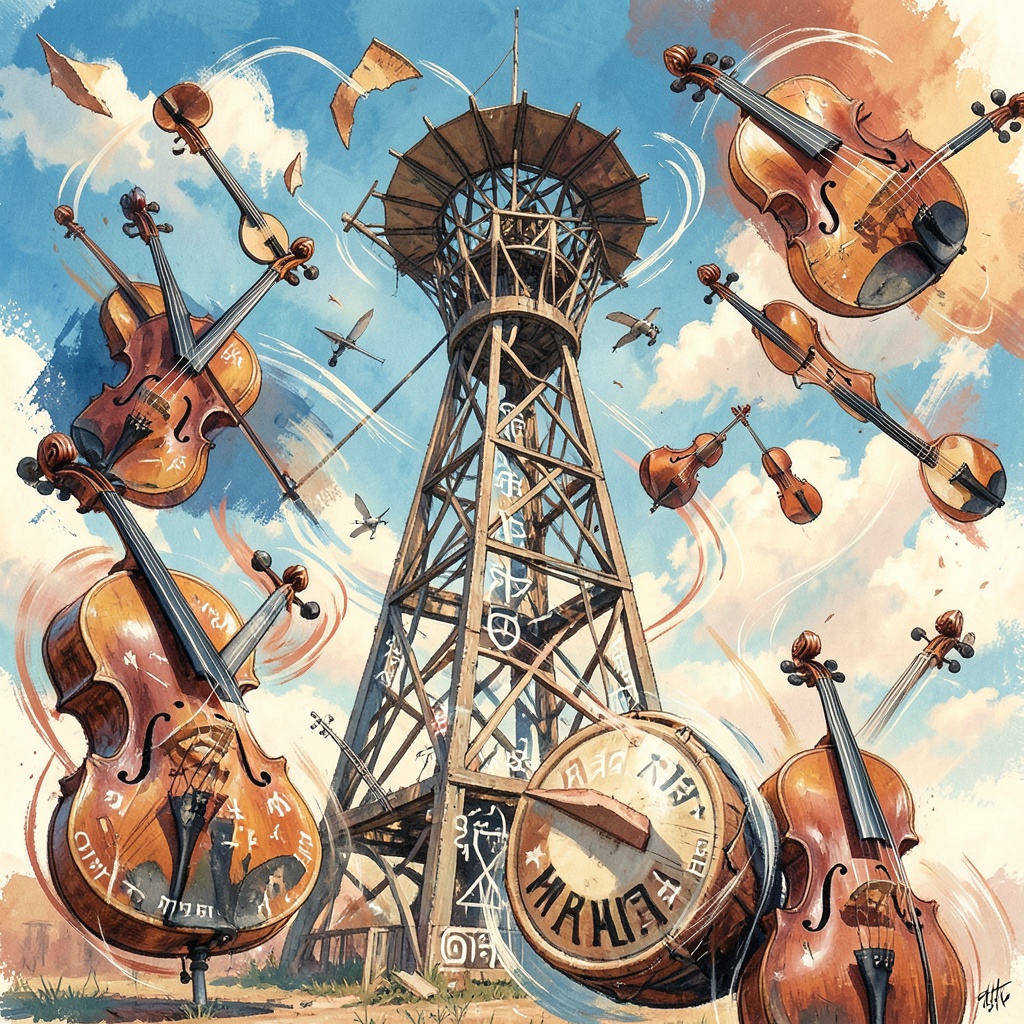
They didn’t take the tower down,
They just renamed the wind.
They took the howl out of the wolf
And made it safe to spin.
They didn’t ban your questions—
Just made the answers thin.
Then handed you a script to read,
And told you truth begins within.
They paved the roads with promises,
And billboards full of light.
They told you that your pain was wrong,
Your anger, impolite.
They didn’t steal your memories—
They made you doubt your sight.
Then thanked you for your loyalty
As you vanished overnight.
The word came first, and then the rule.
They built a school to make you cool.
Then clipped your tongue and trained your thought—
Until you said what you were taught.
No cage, no cell, no chains, no scream—
Just fewer colors in your dream.
No violence here, just grammar games.
Until your prayers all sounded the same.
They didn’t break the poets’ hands—
They paid them to write safe.
Turned rebels into hosts of shows,
And risk into escape.
They offered peace in sterile rooms,
And masks for every face.
And called it growth when no one moved,
And called it grace when we obeyed.
You’ll find no blood beneath the screen,
No echo in the phrase.
Just narrowed hearts, and lowercase gods,
And all the saints replaced.
And still we say it isn’t war—
Because the streets are clean.
But war was never bullet-shaped—
It started in a dream.
The word came first, and then the chains.
The rest was ink. The rest was games.
They made the scream a metaphor,
And told you not to feel it more.
No flags, no guns, no marching feet—
Just empty eyes and endless screens.
And every thought you once believed,
Now sits behind a loading screen.
So whisper loud while you still can.
Say something they won’t understand.
And if your voice begins to shake—
It means there’s something still awake.
No need to shout, no need to fight—
Just hold your words beyond the night.
For words, you see, can burn and bite—
Or tear the veil and birth the light.

On The Art & The Act Of The Warlanguage v2.0 | Lyrics
They didn’t need bombs to burn the sky,
Didn’t drop death from satellites on high.
They came with syllables, sweet and clean—
And taught us all what silence means.
They wrote the truth in vanishing ink,
Sold us the lie before we could think.
They called it peace, they called it law—
And made us kneel with nothing but awe.
Words for war, dressed up in white,
Fed to the children every night.
Say the pledge, forget the pain—
Your voice is gone, but you remain.
They don’t want blood, they want your breath.
Not your body—just your depth.
No extinction, just erasure—
Of will, of wonder, of human nature.
The screens don’t scream—they soothe and blink,
Whispering safety while you sink.
They stole the stars, renamed the seas,
Then branded doubt as a disease.
They took your books and bent the spine,
Rewrote the past, one word at a time.
Thought was treason, speech was crime—
And fiction vanished into rhyme.
Words for war, in quiet rows,
Buried deep where the feeling goes.
They don’t shoot—you volunteer,
Marching mute year after year.
They don’t want your hands or skin—
They want the world you hold within.
They want your soul to be polite,
To dream in black, and not in light.
Imagination—last to fall,
Faint resistance in the crawl.
But once it breaks, and once it’s gone,
You’ll beg to be what you are not.
They feared no bombs, they feared the flame
Of one wild mind that won’t be tamed.
So they fed us safety, spoon by spoon,
Until we sang the corporate tune.
Words for war, written clean—
Erased the soul, replaced the dream.
They changed the meaning of the rain,
Then told us we were dry again.
No wounds, no scars, just missing parts,
No stolen limbs—just stolen hearts.
Not the body, not the flesh—
But the burning urge to ask what’s next.
So speak, while you remember how.
Before your tongue forgets the sound.
Before your thoughts are bought and sold—
And what was once alive grows cold.
The Grammar of Conquest: On Warlanguage & The Rhizomatic Colonization Of The Human Mind

To speak is to construct a world; to speak warlanguage is to lay siege to it.
We live in an era where the battlefield has outgrown its geographic coordinates. It has evacuated the mud of Flanders, the jungles of Vietnam, and the desert sands of Iraq, seeking a more permanent, intimate, and fertile soil: the human psyche. The primary instrument of this migration is not the drone, the rifle, or the missile, but the word. Warlanguage—the systematic weaponization of syntax, semantics, and rhetoric—has become the dominant operating system of modern civilization. It is a linguistic pathogen that does not merely describe conflict, but actively manufactures it, converting the rich, ambiguous, and cooperative landscape of human communication into an endless grid of zero-sum hostility.
To understand the insidious nature of warlanguage, we must abandon the simplistic view that language is merely a passive mirror of reality. Instead, we must adopt a rhizomatic perspective. As conceptualized by Gilles Deleuze and Félix Guattari, the rhizome is an subterranean stem system that grows horizontally, sending out roots and shoots from any point along its path. It has no central trunk, no singular origin, and no definitive boundary; it is a decentralized, self-replicating network of connections. Warlanguage operates precisely in this manner. It does not descend solely from a totalitarian state’s Ministry of Truth down to a passive populace. Rather, it spreads laterally, creeping through the soil of our corporate boardrooms, our digital feeds, our intimate relationships, our scientific paradigms, and our psychological self-assessments. It is an underground network of hostility that links seemingly disparate domains of human life under a single, violent logic.
If we are to preserve the integrity of our minds and the possibility of a shared future, we must map this linguistic rhizome. We must dissect its grammar, expose its lateral expansions, understand its psychological toll, and ultimately, cultivate a praxis of radical semantic resistance.
I. The Anatomy of the Weaponized Word: Semantics as Enclosure
At its core, warlanguage is characterized by the systematic reduction of complexity into binary opposition. It is the syntax of the trench. In a trench, there are only two directions: forward into the enemy, or backward into desertion. There is no room for lateral movement, no space for contemplation, and certainly no allowance for dialogue. Warlanguage imports this spatial brutality into the realm of thought.
In his seminal work on communicative action, Jürgen Habermas distinguished between communicative action—speech aimed at mutual understanding and consensus—and strategic action—speech designed to manipulate others to achieve a specific egoistic goal. Warlanguage is the ultimate manifestation of strategic action, pushed to its absolute, militarized limit. It is not designed to reveal truth, but to capture territory.
This territorial capture begins with the process of semantic enclosure. Just as the Enclosure Acts in Britain privatized the common land, fencing off what was once shared for the benefit of the few, warlanguage encloses the semantic commons. It takes words that once held rich, multi-dimensional meanings—such as "justice," "freedom," "care," "security," and "truth"—and strips them of their nuance, transforming them into ideological munitions.
Consider how the word "security" has been enclosed. Historically, security implied a state of well-being, a collective safety rooted in strong communities, stable resources, and mutual trust. Under the regime of warlanguage, security is hollowed out and reframed exclusively as a defensive posture against an omnipresent threat. It is militarized into "homeland security," "cybersecurity," and "biosecurity." It demands walls, surveillance, policing, and preemptive strikes. To be secure no longer means to live in peace with one's neighbors; it means to possess a more formidable arsenal than them.
This semantic contraction is not accidental; it is a structural necessity of the warlanguage apparatus. When we adopt these militarized definitions, we unwittingly conscript our minds into the service of conflict. We begin to view our world through the lens of the Sapir-Whorf hypothesis: our language shapes our cognitive categories, and those categories determine what we can perceive. If our vocabulary is populated entirely by weapons, every problem we encounter begins to look like a target.
II. The Rhizomatic Spread: Mapping the Lateral Dimensions of Conflict
The true power of warlanguage lies in its horizontal versatility. It does not remain confined to the military-industrial complex; it branches outward, infecting every stratum of human activity. By tracing these lateral roots, we can see how thoroughly our daily lives have been militarized.
                           [ THE WARLANGUAGE RHIZOME ]
                                        │
         ┌──────────────────────────────┼──────────────────────────────┐
         ▼                              ▼                              ▼
 [Corporate Capitalism]         [The Digital Colosseum]        [The Medicalization of Life]
  - "Slaying targets"            - "Meme warfare"               - "Battling cancer"
  - "Poaching talent"            - "Doxxing and cancelling"     - "Invading pathogens"
  - "Hostile takeovers"          - "Weaponized outrage"         - "Autoimmune civil war"
1. The Corporate-Industrial Complex: The Capitalism of Attrition
Nowhere is the lateral expansion of warlanguage more visible than in the lexicon of modern business. The contemporary corporate office is a dry-docked battleship. Employees do not merely work; they are "boots on the ground" executing "strategic maneuvers." They do not complete projects; they "slay targets," "conquer markets," and "crush the competition."
When a company seeks to acquire another, it initiates a "hostile takeover" or deploys "poison pills" and "killer bees" to defend itself. HR departments do not look for skilled human beings; they "poach talent" from "rival camps." When a worker is laid off, they are not a person losing their livelihood; they are "casualties of restructuring" or "collateral damage" in the pursuit of efficiency.
This is not harmless jargon; it is a psychological anaesthetic. By framing economic activity as warfare, corporate leaders can justify cold-blooded exploitation and ecological devastation. If the market is a battlefield, then empathy is a liability, ethical restraint is cowardice, and the extraction of wealth is a heroic victory. The corporate-industrial complex uses warlanguage to desensitize its actors, transforming the cooperative venture of human provisioning into a ruthless war of attrition.
2. The Digital Colosseum: Algorithmic Polarization and Meme Warfare
If the corporate world adopted warlanguage for efficiency, the digital ecosystem has adopted it for survival. The modern internet—specifically social media—is designed around an attention economy that monetizes outrage. To capture attention, content must be sharp, aggressive, and polarizing. It must be weaponized.
We no longer have conversations online; we have "clashes," "slammings," and "eviscerations." Public intellectuals do not debate; they "destroy" their opponents. Ideological groups do not engage in dialectic; they wage "meme warfare" and launch "coordinated harassment campaigns." The term "doxxing"—the malicious publication of private information—is derived from "dropping docs," a phrase with distinctly military overtones of reconnaissance and targeted strikes.
This digital warlanguage is reinforced by algorithms that act as the nutrient soil for this hostile rhizome. By rewarding content that provokes a high-arousal threat response (anger, fear, disgust), social media platforms have effectively conscripted the global population into an ongoing, decentralized civil war. The "retweet" or "share" becomes a salvo; the comment section, a trench. In this digital colosseum, nuance is the first casualty, and the capacity for collective deliberation is utterly demolished.
3. The Medicalization of Life: Pathologizing the Body
The rhizome of warlanguage extends deep into our very flesh. Since the dawn of modern germ theory, medicine has been framed almost exclusively in the vocabulary of warfare. We do not live alongside our microbiome; we "fight infections." We do not support our immune systems; we "mobilize our defenses" against "invading pathogens."
This militaristic framing is most acute in our approach to oncology. Patients do not live with cancer; they "battle" it. They are "cancer warriors" undergoing "aggressive chemotherapy" (a chemical bombardment) and "radiation therapy" (targeted nuclear strikes). If they survive, they have "won their fight"; if they die, they have "lost their battle."
This framing is profoundly damaging. It places an immense, unfair psychological burden on the patient, implying that their survival or death is a matter of personal willpower or martial prowess. Furthermore, it blinds us to ecological and systemic factors. If cancer is an "enemy invader," we focus all our resources on killing the invader inside the body, while ignoring the toxic environments, industrial carcinogens, and systemic stressors that cultivated the disease in the first place. By treating the body as a battlefield, we justify its collateral devastation in the name of victory.
III. The Psychology of Ideological Conscription
To understand why warlanguage is so incredibly seductive, we must examine its psychological utility. Humans are meaning-seeking creatures, but we are also deeply tribal, evolutionary animals wired for survival. Warlanguage capitalizes on these primal drives by offering three powerful psychological payoffs: simplification, belonging, and absolution.
┌─────────────────────────────────────────────────────────────────┐
│              THE PSYCHOLOGICAL CYCLE OF CONSCRIPTION             │
├────────────────────────────────┬────────────────────────────────┤
│ 1. Existential Anxiety         │ The world feels chaotic,       │
│                                │ complex, and threatening.      │
├────────────────────────────────┼────────────────────────────────┤
│ 2. The Binary Injection        │ Warlanguage simplifies reality │
│                                │ into "Us" vs. "Them."          │
├────────────────────────────────┼────────────────────────────────┤
│ 3. Tribal Cohesion             │ Joining the "army" provides    │
│                                │ instant belonging and purpose. │
├────────────────────────────────┼────────────────────────────────┤
│ 4. Moral Absolution            │ Violence (verbal or physical)  │
│                                │ is justified as "defense."     │
└────────────────────────────────┴────────────────────────────────┘
First, warlanguage provides radical simplification. The modern world is dizzyingly complex, characterized by hyper-objects like climate change, systemic economic inequality, and geopolitical instability. These problems do not have easy answers or clear villains. They require deep systemic analysis, patience, and the tolerance of ambiguity. Warlanguage sweeps all of this away. It replaces systemic complexity with a simple, cinematic narrative: there is a good guy (us) and a bad guy (them). By reducing systemic issues to moral battles, warlanguage relieves the individual of the cognitive burden of complexity.
Second, it offers a fierce sense of belonging. Nothing unites a group of people faster than a common enemy. By framing political, cultural, or social differences in terms of warfare, warlanguage instantly creates a tribal bond. You are no longer an isolated individual drifting in a hyper-individualized society; you are a soldier in a grand army, fighting for a righteous cause alongside your comrades. This tribal cohesion is highly addictive, providing a powerful hit of dopamine and a counterfeit sense of existential purpose.
Third, and perhaps most dangerously, warlanguage grants moral absolution. In a state of war, the normal ethical rules are suspended. Cruelty becomes necessity; deceit becomes strategy; empathy for the other side becomes treason. By defining our interactions as warfare, we give ourselves permission to act in ways we would normally find abhorrent. We can dox, harass, dehumanize, and silence our opponents, all while maintaining a warm glow of self-righteousness. We are, after all, only defending ourselves.
This psychological conscription creates a closed cognitive loop. The more we use warlanguage, the more hostile our environment appears; the more hostile our environment appears, the more justified we feel in using warlanguage. This is the feedback loop of polarization, and it is dragging our societies toward catastrophic fragmentation.
IV. The Geopolitics of Propagandistic Deceit: Manufacturing Consent through Euphemism
While warlanguage operates rhizomatically through culture, we must not overlook its concentrated use by the state and the ruling classes. Here, warlanguage takes on a dual, paradoxical character: it is simultaneously hyper-violent and hyper-euphemistic. It uses language to mask the brutal reality of physical violence, while using the logic of violence to colonize peaceful domains of policy.
George Orwell, in his classic essay Politics and the English Language, noted that political speech is largely designed "to make lies sound truthful and murder respectable, and to give an appearance of solidity to pure wind." The state achieves this by employing a specialized dialect of warlanguage that we might call bureaucratic pacification.
When a government drops bombs on a civilian population, it does not call it slaughter; it calls it "surgical strikes" designed to minimize "collateral damage." When it kidnaps and tortures individuals outside the bounds of international law, it engages in "extraordinary rendition" and "enhanced interrogation." When a military unit accidentally kills its own members, it is labeled "friendly fire."
This is the sanitizing face of warlanguage. It uses clinical, technocratic, and abstract terminology to sever the connection between the word and the visceral reality of suffering. It allows policymakers to sign death warrants from the comfort of mahogany offices without ever having to confront the blood on their hands.
       [ REALITY ]                         [ WARLANGUAGE FILTER ]                    [ PERCEPTION ]
  Civilian Slaughter       ───────►     "Collateral Damage"         ───────►    Regrettable Necessity
  State Kidnapping & Torture ─────►     "Extraordinary Rendition"   ───────►    National Security
  Accidental Self-Killing  ───────►     "Friendly Fire"             ───────►    Tragic Accident
Conversely, when the state wishes to mobilize public resources and suppress dissent domestically, it imports the language of actual warfare into non-military issues. Thus, we have the "War on Poverty," the "War on Drugs," the "War on Terror," and the "War on Cancer."
By declaring "war" on social problems, the state achieves several key objectives:
- It frames the issue as an existential emergency, justifying the bypass of democratic debate and civil liberties.
- It demands unquestioning obedience and patriotism from the citizenry.
- It identifies a clear, domestic "enemy" (the drug user, the immigrant, the unpatriotic dissenter) who can be legitimately targeted, policed, and incarcerated.
The "War on Drugs," for instance, did not cure addiction; instead, it served as a convenient rhetorical screen for the mass incarceration of marginalized communities and the militarization of domestic police forces. The rhetoric of war transformed a complex public health issue into a domestic military campaign, with devastating social consequences. Warlanguage is the ultimate tool for manufacturing consent, turning the citizen into a soldier and the state into an occupying army.
V. The Counter-Offensive: Cultivating a Rhizome of Peace
How do we break free from this semantic stranglehold? How do we dismantle a linguistic system that is so deeply embedded in our institutions, our technologies, and our psyches?
We cannot defeat warlanguage by declaring "war" on it. To do so would be to fall into its very trap, validating its binary logic and using its own weapons to fight for peace. This is the paradox of the anti-war movement that relies on aggressive, combative rhetoric: it feeds the very beast it seeks to slay.
Instead, our resistance must be rhizomatic, generative, and lateral. We must not meet warlanguage head-on in a battle of attrition; we must grow around it, beneath it, and beyond it. We must cultivate a defensive literacy and a restorative syntax that renders warlanguage obsolete.
                         [ THE DIALECTIC OF LINGUISTIC RESISTANCE ]

     ┌──────────────────────────────────────┐        ┌──────────────────────────────────────┐
     │         THE WARLANGUAGE GRID         │        │       THE GENERATIVE ECOSYSTEM       │
     ├──────────────────────────────────────┤        ├──────────────────────────────────────┤
     │ - Binary (Us vs. Them)               │        │ - Rhizomatic (Multi-dimensional)     │
     │ - Territorial (Capture & Enclose)    │   VS   │ - Ecological (Nurture & Connect)     │
     │ - Transactional (Zero-Sum)           │        │ - Transformational (Win-Win)         │
     │ - Linear (Target & Eliminate)        │        │ - Circular (Iterate & Understand)    │
     └──────────────────────────────────────┘        └──────────────────────────────────────┘
1. The Practice of Semantic De-escalation
The first step in this counter-offensive is personal and immediate: we must practice semantic de-escalation in our daily speech. This requires a hyper-vigilant mindfulness of the metaphors we use.
When we are in a disagreement with a colleague, partner, or political opponent, we must consciously reject the metaphor of argument-as-war. In his book Metaphors We Live By, George Lakoff points out that we almost always frame arguments in terms of war: we "win" or "lose" arguments, we find "weak points" in our opponent's position, we "shoot down" their ideas, and we "target" their inconsistencies.
What if we chose to view argument not as a war, but as a dance, a tapestry, or a collaborative exploration?
- If an argument is a dance, the goal is not to knock the other person down, but to move gracefully together, creating a beautiful, shared motion.
- If an argument is a tapestry, we are weaving together different threads of experience to create a richer, more complex picture of reality.
- If an argument is an exploration, we are co-travelers hacking through the jungle of ignorance to find a path toward truth.
By shifting our metaphors, we shift our cognitive posture. We move from a state of threat defense to a state of curious engagement. We lay down our verbal arms and open ourselves up to the possibility of being transformed by the dialogue.
2. The Reclamation of the Semantic Commons
We must actively resist the semantic enclosure of our language. This means reclaiming words that have been hijacked by warlanguage and restoring their original, expansive meanings.
Take, for instance, the word "patriotism." Under the regime of warlanguage, patriotism has been enclosed to mean blind loyalty to the state, xenophobic nationalism, and the willingness to support military aggression. We must reclaim patriotism to mean a deep, critical love for one's land and community—a love that manifests as holding one's government accountable, protecting the local ecology, and ensuring that all members of the community can flourish.
Similarly, we must reclaim the concept of "strength." Warlanguage equates strength with the capacity to inflict violence, to dominate, and to remain invulnerable. We must assert that true strength lies in the capacity for vulnerability, the willingness to listen, the resilience to endure suffering without passing it on, and the courage to extend trust in the face of fear.
3. The Cultivation of Defensive Literacy
In an era of algorithmic warfare and state propaganda, defensive literacy is not an intellectual luxury; it is a survival skill. We must train ourselves and our children to recognize the markers of warlanguage wherever they appear.
This means asking critical questions of the media we consume:
- What metaphors are being used here? Are they military, mechanical, or ecological?
- Is this language trying to make me feel threatened? Is it pushing me into a binary "us vs. them" trap?
- What human realities are being hidden behind these euphemisms?
- Who benefits from me viewing this issue as a war?
By developing this critical distance, we inoculate our minds against ideological conscription. We refuse to let our attention be harvested and our emotions weaponized by the merchants of outrage.
4. Designing Generative Communication Infrastructures
Finally, we must build new, decentralized platforms and spaces that are structurally hostile to warlanguage. If our current digital platforms reward polarization because of their business models, we must design and support alternative infrastructures.
We need social technologies that are modeled not on the colosseum, but on the forest floor. In a forest, trees communicate and share resources through a subterranean mycorrhizal network—a literal, biological rhizome of mutual aid. We must build digital and physical spaces that facilitate this kind of communication:
- Platforms that reward slow, deep, and reflective dialogue rather than rapid-fire outrage.
- Democratic processes, such as citizens' assemblies, that bring diverse groups of people together to deliberate face-to-face on complex issues, bypassing the binary traps of party politics.
- Educational systems that prioritize emotional intelligence, media literacy, non-violent communication, and the appreciation of systemic complexity.
VI. The Call to the Linguistic Commons
The crisis of our age is not merely political, economic, or ecological; it is semiotic. We cannot build a peaceful, just, and sustainable world using the very grammar that tore it apart. Warlanguage is a self-fulfilling prophecy; it creates the hostile world it claims to protect us from.
Every time we speak, we are making a choice. We can choose to be soldiers in an endless, rhizomatic war of words, fencing off meaning, targeting our opponents, and laying waste to the shared landscape of our humanity. Or we can choose to be gardeners of the linguistic commons.
To choose the garden is to embrace a language of complexity, relationship, and regeneration. It is to recognize that the "other" is not an enemy to be destroyed, but a collaborator in the ongoing, unfinished project of human understanding. It is to speak with a syntax that heals rather than wounds, that opens rather than closes, and that connects rather than divides.
Let us lay down our verbal armor. Let us dismantle our rhetorical trenches. Let us step out into the open field of genuine conversation, and there, beneath the noise of the battlefields, let us begin, at last, to speak to one another.
On The Art & The Act Of The Warlanguage v5.0 | The Lyrics
Teeth full of sand
Boots full of names
Maps on my skin
All of them flames
We trade in rumors
Bullets and breath
Laugh at the ceiling
Betting on death
I talk in targets
You talk in scars
We both keep secrets
Buried in jars
This is the war tongue
Sharp as shrapnel in the lung
Every word a loaded drum
Say it once and you go numb
This is the war tongue
Prayers packed tight in the gun
I don’t speak of what I’ve done
I just taste it on my tongue (yeah)
Rations of silence
Passed hand to hand
Truth goes missing
Somewhere in transit
We count the bodies
Never the years
Dust in the lashes
Salt in the gears
I dream in orders
Red ink and codes
Wake up already
Walking in roads
This is the war tongue
Sharp as shrapnel in the lung
Every word a loaded drum
Say it once and you go numb
This is the war tongue
Prayers packed tight in the gun
I don’t speak of what I’ve done
I just taste it on my tongue (war tongue)
Who were we
Before the numbers
Before the briefings
Before the thunder
What will we be
When all is spoken
When all the flags
Come down broken
This is the war tongue
Sharp as shrapnel in the lung
Every word a loaded drum
Say it once and you go numb
This is the war tongue
Prayers packed tight in the gun
I don’t speak of what I’ve done
I just taste it on my tongue (my tongue)
 Outlaw Creative
 Outlaw Creative
 Outlaw Creative