Before He Rode With Hope — Carl, The Sad Sad Pastry
The Photograph.
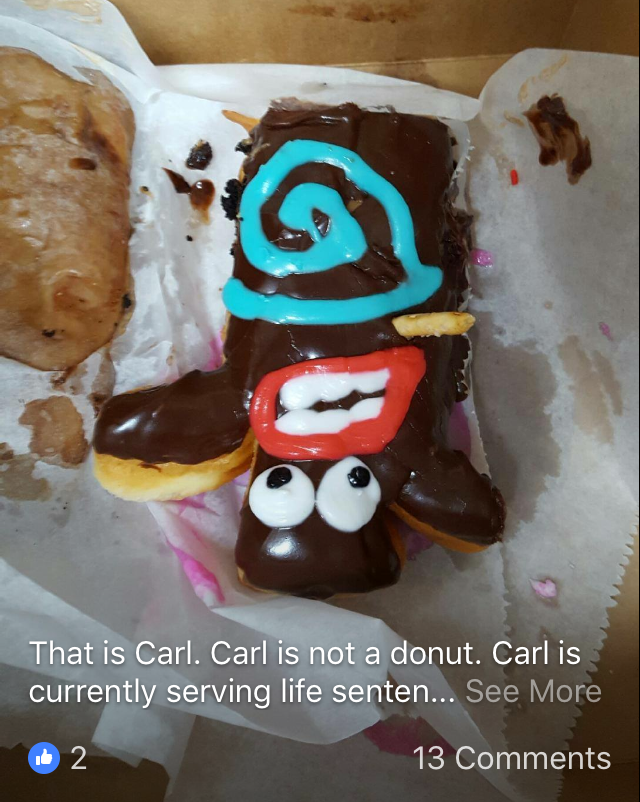
There is a photograph. Everything else has to answer to the photograph.
A piece of pastry lies on wax paper inside a box. Chocolate on the body. Blue spiral of icing where some badge, wound, target, or unasked-for emblem might have been. Red icing mouth with white teeth arranged into a scream or a grin, depending on whether the viewer is in a generous mood. Two white eyes down near the bottom, looking not so much upward as outward, in that manner peculiar to things that have been brought into the world without being properly consulted.
The photograph was sent by Jennifer years ago.
That is the beginning. Not the Muffin Court. Not the Pastry Task Force. Not Hope with two blades. Not Two-Guns with the loaded appetite and the criminal relationship to cookies. There was only Jennifer, somewhere on the other side of the sending, and William receiving a picture of an object so completely itself that it did not require improvement. It required recognition.
Carl.
Carl was not beautiful. Carl was not cleanly made. Carl was not a little masterpiece of bakery craftsmanship presented for admiration behind glass. Carl looked as though he had entered existence during a disagreement among ingredients. He looked accused before the trial. He looked sentenced before anyone had identified the charge.
And almost immediately, the primary defense had to be entered into the record:
Carl is not a donut.
That statement was not ornamental. It was not a cute correction. It was the first act of justice anyone ever performed on his behalf.
The Trouble With Form.
The trouble began with the eye. Not Carl’s eyes. The eye looking at Carl.
There are things the eye wants to do quickly. It wants to recognize. It wants to classify. It wants to put what it sees in a familiar drawer so it can go about its business. Round thing: donut. Frosted thing: dessert. Sad thing: joke. Strange thing: malformed version of something proper.
Carl was in danger from the beginning because he could be seen faster than he could be understood.
That is how a pastry ends up imprisoned by an error. Somebody looks at the irregular body, the chocolate casing, the wounded blue spiral, the big white eyes, and decides that the important question is what he failed to be. A bad donut. A collapsed muffin. A baked mistake. The kind of thing a person photographs because it is funny and then throws away when the laughter is over.
But Carl did not look disposable. That was the disturbance. He looked humiliated, certainly. He looked ridiculous beyond appeal. But he also looked present. He had crossed over somehow. The frosting had stopped decorating the pastry and started testifying on its behalf. The eyes did not say, “Look what happened in the kitchen.” The eyes said, “I am aware that you are looking. Proceed carefully.”
Some creatures are born with dignity. Carl had to acquire his in public, while lying facedown on wax paper with a red scream-mouth and the entire court prejudiced against him.
This is how Carl came under the first law of the pan: you fit, or you spill.
He spilled.
Or so they said.
The First Sentence.
Somewhere near the photograph, the words arrived: Carl is currently serving a life sentence.
That was the true beginning of his mythology, because it named what could be seen in his face. Carl did not merely have sadness. Carl had duration. His sorrow was not the quick sadness of a dropped dessert or an uneaten pastry at the end of a breakfast shift. His was institutional sorrow. He had been placed somewhere and informed that his position there was permanent.
What was the crime?
The record is unclear.
Possibly he failed to rise to specification. Possibly he resisted glazing. Possibly he was formed under circumstances the bakery preferred not to make public. Possibly he committed some grave offense in an earlier life involving éclairs, an accomplice made of jellyroll, and a buttercream shank.
But the likelier explanation is more severe: Carl had been sentenced for what he was unable to resemble.
This happens. A thing appears in the world outside the accepted shape, and the world interprets the difference as guilt. The crooked body becomes evidence. The damaged surface becomes confession. The failure to fit the expected category becomes a reason to keep the thing behind glass.
Carl, therefore, was not merely sad. He was the Sad Sad Pastry: one sadness for the suffering itself, and another for being made to answer for it.
Before Hope.
Before Hope, there was no doctrine of rescue.
There was a box.
The box may have been bakery cardboard in the historical record, but in the life of Carl it became considerably more. It became his architecture. The box was what the world thought sufficient for him. It gave him four walls, a wax-paper floor, and just enough room for his eyes to accuse anyone who opened the lid.
A box is a dangerous object because it can be mistaken for care. It protects the contents. It carries the contents safely. It keeps a messy thing from touching the clean table. It makes the strange thing portable.
Years later, after Hope had been captured and Carl made the decision that would establish his standing among the outlaws, he would say what only a boxed creature could know:
A box is just a cage that they carry for you.
He did not learn that on the road. He did not learn it from Hope’s work orders. He learned it early, before there was language for it, lying there beneath the gaze of those who found him funny, sad, badly made, or difficult to identify.
This is why he could go back in the box for Hope.
Not because he had conquered his fear of it. Not because the box no longer meant anything to him. He went back because it meant everything. He knew exactly what it was to be placed inside a shape chosen by someone else. He knew what it was to hear the lid close above a name no one had bothered to learn.
Hope did not belong there.
For once, Carl could put his sorrow to use.
The Muffin Man.
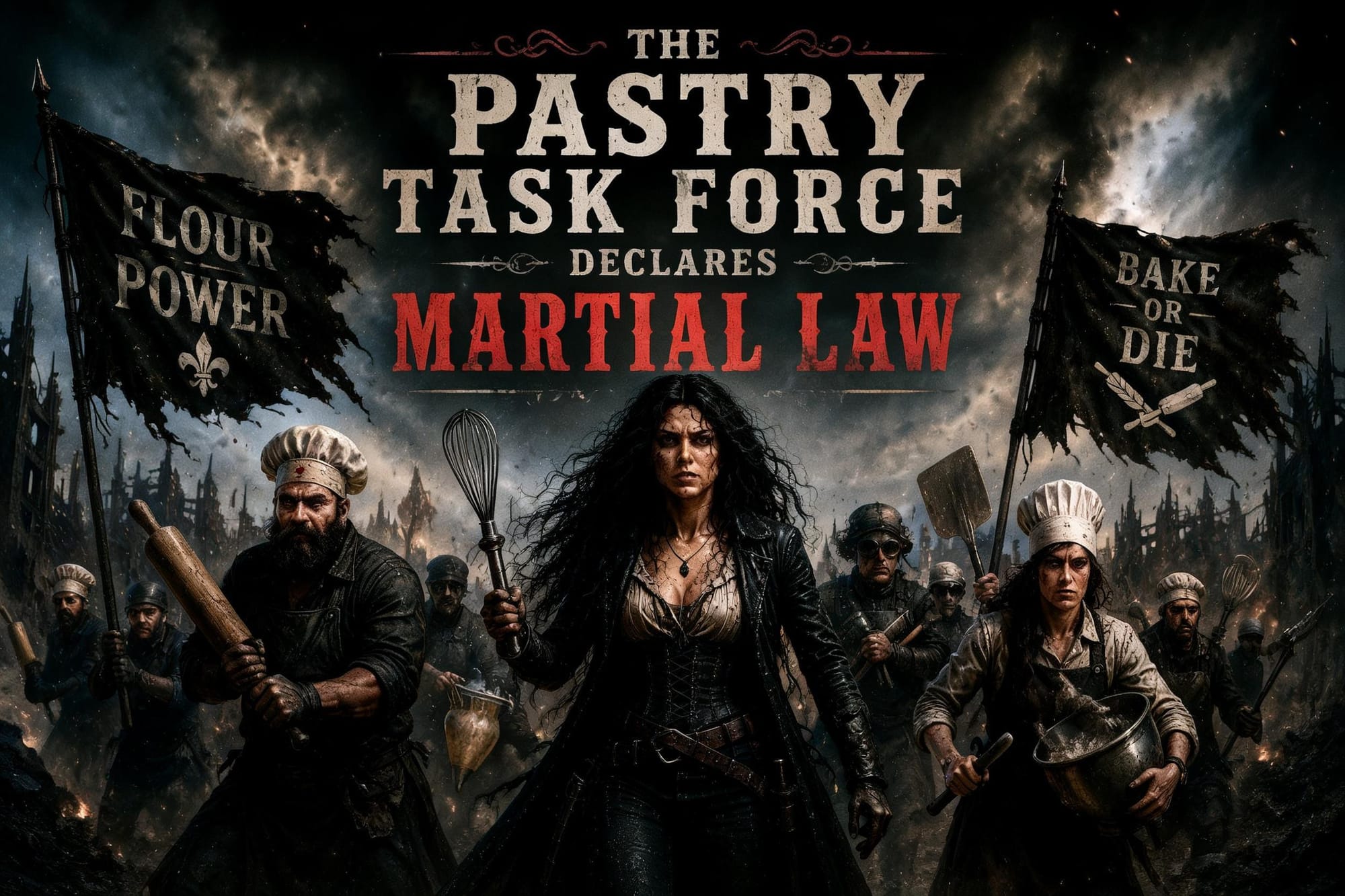
Long before the Pastry Task Force stamped him MUFFIN-ADJACENT THREAT, Carl had already encountered the old philosophy of the pan.
The Muffin Man did not create Carl’s sadness. That would give him too much credit. He did something colder. He explained it.
The Muffin Man had no need for theatrical hatred. He believed in process. Heat. Timing. Boundaries. He believed the pan asked a fair question and whatever emerged from the oven supplied a fair answer. If something rose, it had deserved its form. If something collapsed, stuck, burned at the edges, or had to be scraped out with shame and a spoon, that was not cruelty.
That was calibration.
His doctrine could be spoken in a few clean lines:
I am not the recipe.
I am not the oven.
I am not the hope.
I am where hope goes
to find out if it deserved heat.
For a creature like Carl, there is no more dreadful authority than one who does not hate him personally. Personal hatred can be fought. It can be exposed. It can exhaust itself. But procedure has no face to strike. It observes the result and calls the result deserved.
Carl did not fit the pan.
The Muffin Man did not ask whether the pan had been wrong.
That question would have to wait for Hope.
Jennifer’s Part.
It is important not to make Jennifer responsible for everything Carl became. She did not know she was transmitting an outlaw figure into a future archive. She did not send a manifesto. She sent a photograph.
But photographs are strange doors. A person can send an image in one hour of one ordinary day and discover, much later, that the image kept working after the conversation was over. It lay there. It waited. It retained its little charge.
Jennifer gave Carl his first crossing.
That is enough.
Later, William would make songs for Jennifer: songs of lift, of bird day, of continuing to rise, of the particular victory involved in remaining intact enough to carry one’s own light. Those songs belong to her in their own way. They are not Carl’s songs. Carl does not need to intrude upon every bright place merely because he once came from her direction.
But there is a small and proper connection between them.
Jennifer sent the figure who could not yet rise.
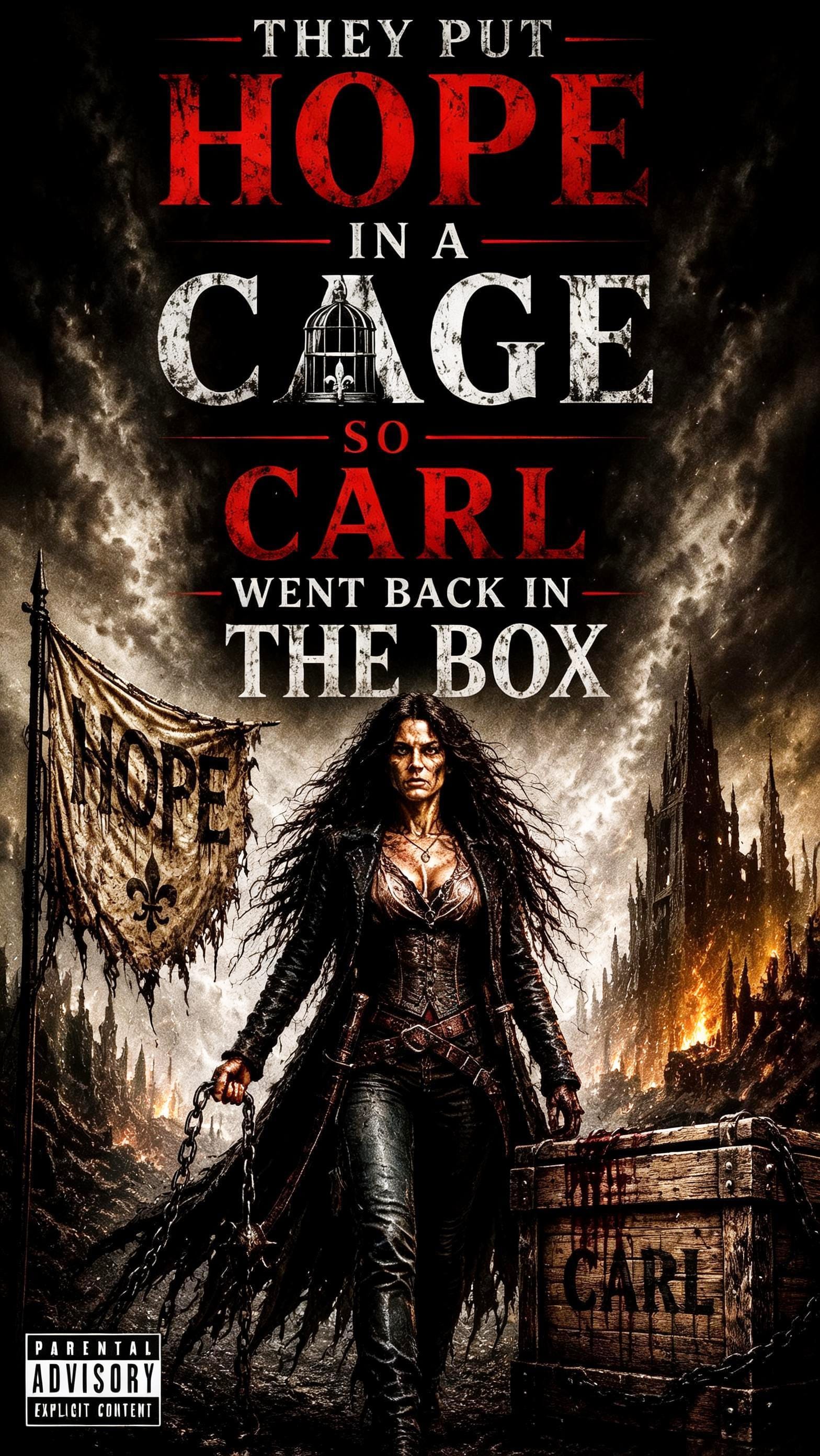
Then years later, Carl entered songs about opening boxes, breaking cages, surviving the wrong name, and riding beside Hope.
Somewhere between the sent photograph and the returned songs is the quietest kind of gift: a thing given lightly that turned out to have a whole life inside it.
Two-Guns.
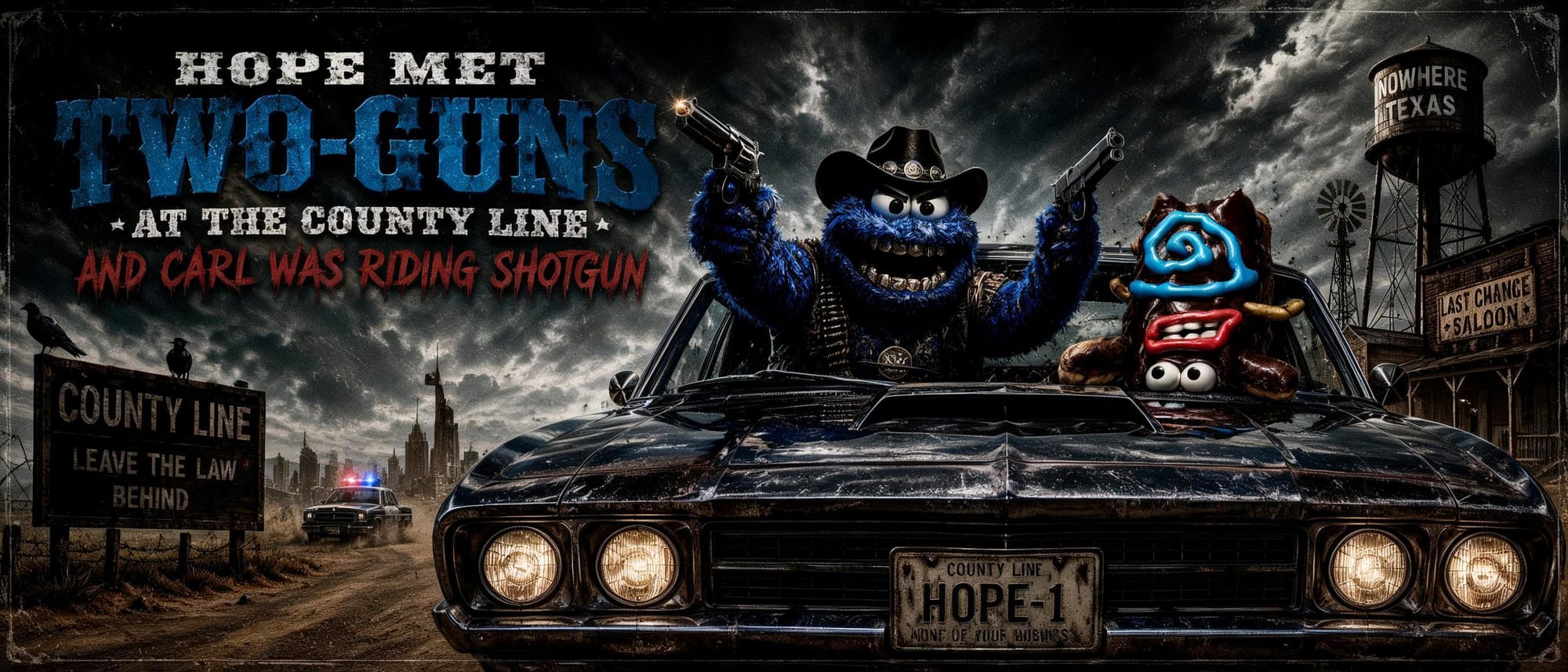
Cookie Gangster Monster Two-Guns did not meet Carl at his best.
This matters.
Carl was not discovered on a mountaintop, standing nobly against oppression, blue spiral blazing like a badge of destiny. He was found in custody. Serving time. A pastry behind glass. A figure with all the evidence of defeat upon him.
Two-Guns, being a creature of appetite rather than judgment, did not require Carl to be impressive first. A blue-furred outlaw storming a bakery during a cookie-based crime does not pause for proper classification. He sees an odd little chocolate figure in trouble and understands only the immediate question:
You coming or not?
This may be the first kindness Carl received that was not pity.
Two-Guns did not say Carl looked sad. He did not say Carl looked damaged. He did not ask why Carl had been boxed. He offered him a getaway.
Carl accepted.
That is how many true lives begin: not with explanation, not with therapeutic repair, but with one criminally irresponsible friend making space in the sidecar.
Hope.
Hope was different.
Hope did not rescue Carl first. By the time Carl came to Hope, he had already broken out. He was already riding with Two-Guns. Already wanted. Already carrying the strange dignity of a creature who has fled the place designed to contain him.
Hope gave him something freedom alone cannot provide.
Work.
Not labor. Not usefulness measured by another person’s demands. Work in the old, hard sense: a thing worth doing because it answered the very harm that had once been done to him.
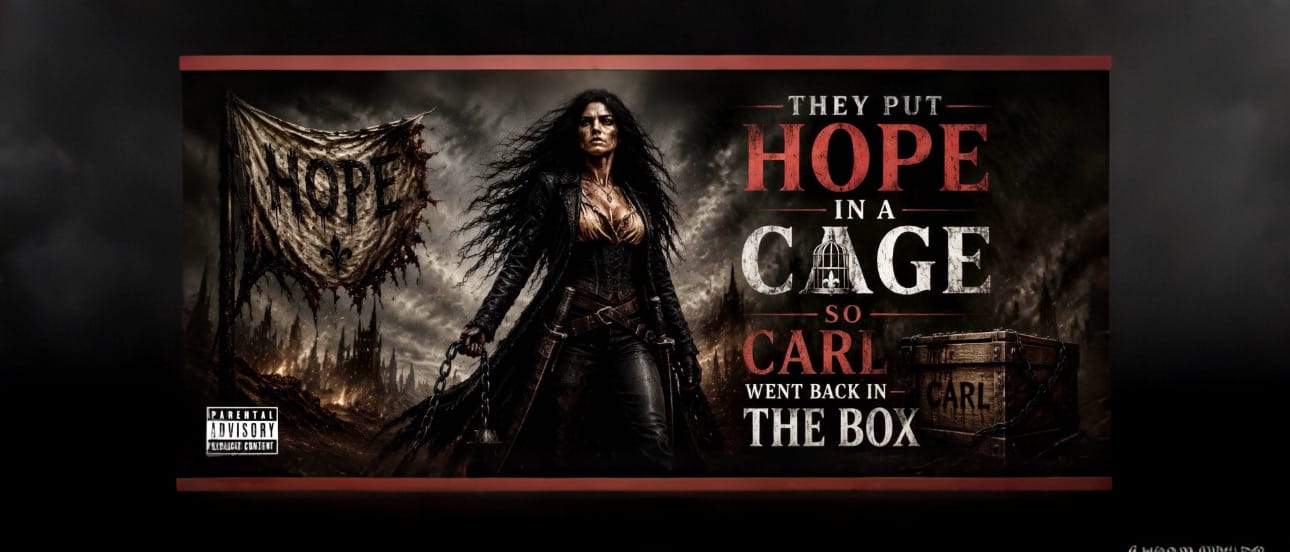
Hope dealt in cages. Carl understood boxes.
Hope dealt in lies. Carl had been named by one.
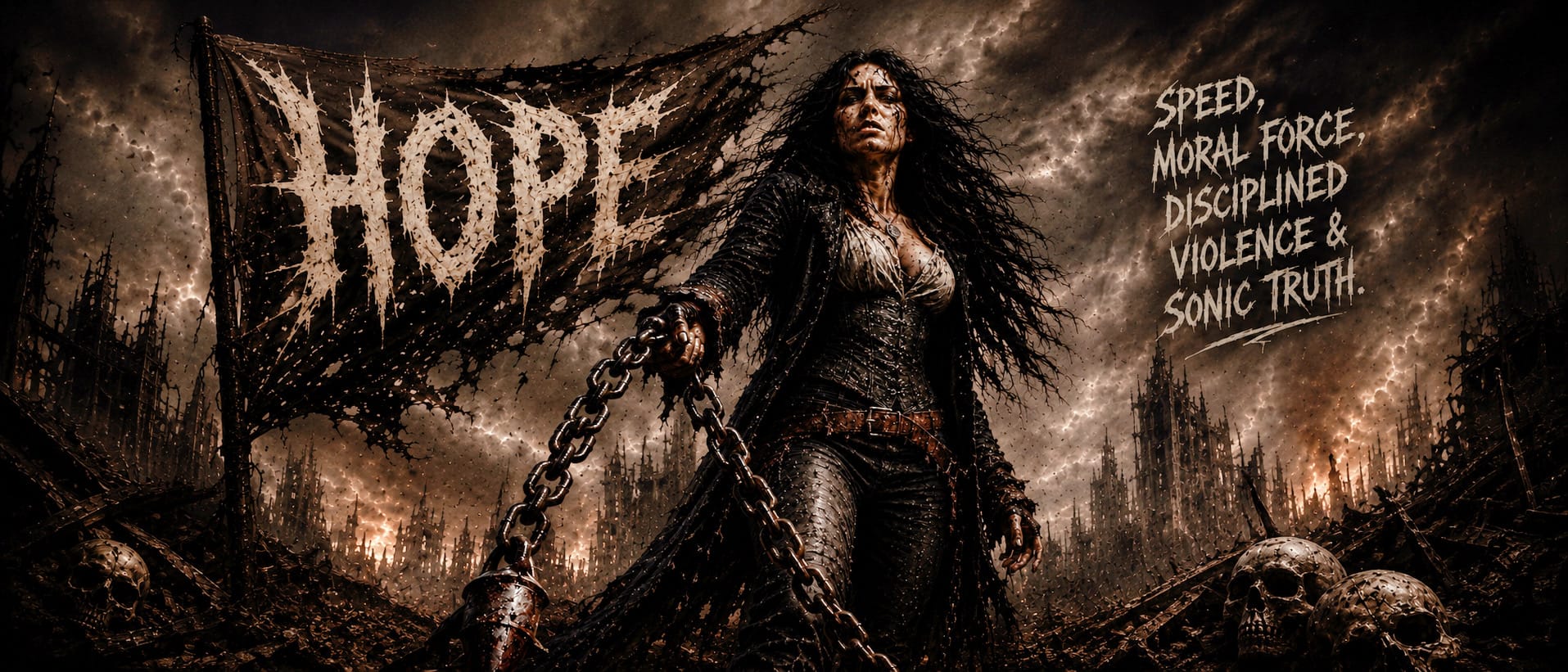
Hope carried two blades: one for the visible machinery, one for the invisible sentence that tells a captive the cage is his proper home.
Carl understood, perhaps before anybody else, why the second blade could not simply be swung at a person. He knew the violence of being defined by another’s idea of what he ought to become. A pastry told he is a muffin does not need a rescuer who arrives with another compulsory shape.
So he sat on the turned-over crate.
He said, “I know glass. I know how to wait.”
That was Carl’s wisdom. It did not come from being whole. It came from having been looked at wrongly for a very long time.
The Name.
Then came the greatest insult: after every correction, after every escape, after the courthouse, after the box, after the declared martial law, Carl was abducted by frightened people who thought he was the Muffin Man.
Not merely a muffin.
The Muffin Man.
The authority behind the very logic that had held him guilty for not fitting.
There is a particular horror in being mistaken for the system that harmed you. Carl had been classified, displayed, sentenced, boxed, and pursued. Then people wrapped him in a blanket marked HUMANITY FIRST and carried him away as though he were the agent of the crime.
He protested with the clarity of a creature exhausted by metaphysics:
I am pastry. I am sad. I have papers and a heart.
They took the protest as evidence.
That is what false stories do when they grow strong enough: they become incapable of receiving contradiction. Everything is absorbed. Denial proves the plot. Tears prove manipulation. A name proves programming.
Then Hope arrived. Then Two-Guns opened the locks. Then Carl stood beneath the interrogation light, wax paper torn beneath his feet, and spoke the name he had paid for:
CARL THE SAD SAD PASTRY, YOU MISINFORMED BORES!
This was not comic relief. It was his declaration of existence.
Rise. Tell me your name.
Carl rose.
Carl told them.
Where He Stands Now.
The photograph remains. It has not become less funny because the story became serious. Carl still looks absurd. The eyes are still too much. The red icing mouth still makes a face no respectable bakery ought to permit. The blue spiral still raises questions for which no sober answer is available.
Good.
Carl’s greatness is not that the ridiculous appearance concealed a dignified interior all along, and that the proper response was to stop laughing. No. Carl is dignified and ridiculous at once. His comic form is not the enemy of his moral weight. It is the route by which the weight arrived without putting up a sign announcing importance.
Comedy is a weapon that pretends to be a toy.
Carl is the living proof.
He came in as a photograph from Jennifer. He lay there in a pastry box, serving life for some unspecified offense against form. He became a tune. He acquired an accomplice. He met Hope. He went back in the box for her. He watched Two-Guns surrender the last cookie. He stood beside the second blade and learned that release cannot be imposed. He was misidentified by terrified vigilantes, discovered the paper trail of his wrongful classification, and now rides east toward the courthouse made of flour and old wrong names.
He has a warrant in his hand.
He has friends behind him.
He has no intention of being re-boxed.
And when he finally stands before Chief Justice Muffin, the question will not be whether Carl fits the pan.
The question will be who gave the pan authority to judge him.
Years ago, Jennifer sent a photograph.
Somewhere inside it, Carl was already looking back.
Waiting for his name to be called correctly.
And there he is: Carl before the Muffin Court, but with the whole road behind him now.

Carl The Sad Sad Pastry
Attention all units
Suspect has been identified
Name: Carl
Classification: pastry
Emotional condition: sad
Criminal condition: worse
Do not be fooled by the frosting
Carl is currently serving a life sentence
[Gang Shout]
NO PAROLE!
Born in a bakery under flickering light
Chocolate coat in the dead of night
Two white eyes and a scream for a grin
Blue spiral branded where the bad got in
They put him behind glass on a wax-paper cot
Said, “Carl, you’re a pastry, you ain’t what you’re not”
But Carl had a hunger no glaze could hide
And a little fried felony deep inside
He watched the donuts leave by the dozen each day
Watched the coffee cups come and carry them away
He said, “I ain’t round, and I ain’t no saint
I’m the kind of thing your prayers can’t paint”
[Pre-Chorus]
Sad little pastry
Cold little tray
Serving life where the sweet things lay
Sad little pastry
Chocolate disguise
Nobody trusts them googly eyes
Carl! Carl!
The Sad Sad Pastry!
Frosted for life and guilty as sin
Carl! Carl!
The Sad Sad Pastry!
Locked in the box but the crime’s within
He ain’t a donut
He ain’t free
He’s doing time in a bakery
Carl! Carl!
The Sad Sad Pastry!
Life sentence served with sprinkles on top
SERVE IT HOT!
He got pinched one morning at the Cinnamon Bank
With a jellyroll driver and a buttercream shank
Cupcake witness took the stand and cried
“He ate three éclairs and he laughed when they died”
Judge was a muffin with a powdered wig
Said, “Son, what you’ve done is uncommonly big
You may be sweet, but the court don’t play
I sentence your ass to the display tray”
Carl yelled, “Mercy!” with a chocolate tear
But the bailiff bear claw dragged him out by the ear
They sealed his box with a sticker of shame
And the whole damn bakery remembered his name
Sad little pastry
Bars made of glass
Smiling like a fool with a violent past
Sad little pastry
Red icing mouth
Planning something terrible down in the south
Carl! Carl!
The Sad Sad Pastry!
Frosted for life and guilty as sinCarl!
Carl!
The Sad Sad Pastry!
Locked in the box but the crime’s within
He ain’t a donut
He ain’t free
He’s doing time in a bakery
Carl! Carl! The Sad Sad Pastry!
Life sentence served with sprinkles on top
NO PAROLE!
NO CONTROL!
NO DONUT HOLE!
Then one black night when the ovens went cold
A blue-furred outlaw came reckless and bold
Two chrome opinions, crumbs on his vest
Looking for cookies and resisting arrest
He busted the jar and he cleaned out the rack
The pastry task force came rolling out back
But right in the middle of the chocolate-chip raid
Carl gave a wink from the tray where he laid
Two-Guns froze
Said, “You coming or not?”
Carl cracked a grin through the frosting he’d got
“Heard you need muscle for a getaway trip
I got nothing to lose but this sugar-glazed grip”
Was he a hostage?
Was he in cahoots?
Nobody knows but the crumbs and the boots
When the bakery cameras all fizzled and died
Carl The Sad Sad Pastry was riding shotgun outside
There comes a timeIn every pastry’s life
When a man must decide
Whether he is breakfast
Or whether he is vengeance
Carl had sat long enough
Under fluorescent judgment
Carl had heard enough people say
“Is that supposed to be a donut?”
No
Carl was not a donut
Carl was a reckoning
With frosting
Break the box
Crack the tray
Sad Sad Pastry got away
Glaze on glass
Blue-fur tracks
Pastry task force under attack
Serve no time
Take no plea
Carl ain’t dying in captivity
Two-Guns rides
Carl reloads
Sugar thunder down the county roads
Who broke out the pastry?
TWO-GUNS!
Who planned the whole damn caper?
CARL!
Who ate the witness list?
TWO-GUNS!
Who smiled through the frosting?
CARL! CARL! CARL!
Carl!Carl!
The Sad Sad Pastry!
Frosted outlaw with a murderous grin
Carl! Carl!
The Sad Sad Pastry!
Whole town knows that the boy got out again
He ain’t a donut
Never was
He’s chocolate-coated outlaw law
Carl! Carl!
The Sad Sad Pastry!
Life sentence broken with
Two-Guns at dawn
Sad! Sad!Pastry bad!
Sad! Sad!Pastry bad!
Sad! Sad!Pastry bad!
Tell the bakery:
Carl ain’t coming back!
By morning, the display case was empty
The sheriff found one note
Written in chocolate
On a piece of wax paper
It said:
I told youI am not a donut
Down the road
Two-Guns laughed
And Carl?
Carl smiled for the first time in his miserable frosted life
Which somehow made him look worse
No parole
Off The Rails: Everybody Knows Not To Mess With The Muffin Man | Lyrics
I am not the recipe.
I am not the oven.
I am not the hope.
I am where hope goes
to find out if it deserved heat.
You don’t argue with me.
You don’t negotiate.
You don’t freestyle.
You fit
or you spill.
I do not care how inspired you felt
when you were mixed.
I care what you do
when you rise.
Some of you collapse.
Some of you burn at the edges.
Some of you stick
and have to be scraped out
with shame and a spoon.
This is not cruelty.
This is calibration.
You wanted form.
You got boundaries.
Learn the difference.
Celebrity Death Match: Pastry Edition
Ladies and gentlemen—
one for the money,
two for the show,
three to get ready—
four to get baked.
IN THIS CORNER:
The Muffin Man.
No gimmicks.
No lore.
Just heat, timing, and consent.
IN THE OTHER CORNER:
Carl the Sad Pastry—
existential, iced too early,
eyes asking questions frosting cannot answer.
And sneaking in from stage left—
The Cookie Monster.
All appetite.
No brakes.
Pure crowd energy.
The bell rings.
Cookie Monster rushes in.
Big mistake.
Sugar high meets thermal law.
Carl hesitates—
and hesitation is fatal in a kitchen.
The Muffin Man doesn’t swing.
He doesn’t taunt.
He doesn’t monologue.
He waits.
Because everyone here knows the rule:
You don’t beat the Muffin Man.
You get converted.
Cookie Monster hits the pan first.
Carl follows.
Sizzle.
Applause.
Crumbs where there used to be philosophy.
WINNER:
Not violence.
WINNER:
Process.
Final Seal
Comedy Is a Weapon That Pretends to Be a Toy
Here’s the trick:
If you announce the weapon,
people put their shields up.
If you hand them a toy,
they lower their guard
and hand it back sharper.
Comedy is how truth
gets past the bouncer.
It jingles.
It dances.
It tells you it’s harmless.
Then—
when everyone’s relaxed—
it rearranges the furniture
in their head.
The joke leaves first.
The insight stays late.
That’s why absurdity works.
That’s why sincerity lies.
That’s why the Muffin Man never laughs.
He doesn’t need to.
The pan already taught the lesson.
Carl Before The Court (Let's Sing Him Home!) | Lyrics
Hear ye, hear ye:
The Supreme Muffin Court is now in session
Presiding:
Chief Justice Merv The Muffin
Charge before the court:
One Carl The Sad Sad Pastry
Flight from lawful display
Unauthorized Hope
Cookie-based insurrection
Refusal of proper classification
All rise
Road ran east through a flour-white dawn
Carl held the warrant with his little jaw drawn
Hope rode steady with both blades still
Two-Guns checked the chamber of his cookie belt
At the end of the road stood a courthouse high
Smoke from the chimney spelling FIT OR FRY
Pans on the windows, locks on the gate
A marble sign saying FORM DECIDES FATE
Inside sat pastries bent in rows
Every wrong-shaped thing in powdered clothes
Then the doors swung wide and Carl walked in
Blue spiral burning, red mouth grim
The clerk cried, “Muffin Man, report to the stand!”
Carl said, “Get my name right while you still got a hand.”
Stamp on the page
Heat in the hall
One small pastry facing all
Carl before the Muffin Court
Standing where the wrong names start
They said, “You fit or you spill”
Carl said, “I got a name and a will”
Carl before the Muffin Court
No more box and no retreat
“I am not your failed muffin
I am Carl
And I am on my feet”
NOT! A! MUFFIN!
NOT! A! DONUT!
SAY! HIS! NAME!
CARL!
Chief Justice Merv The Muffin rose powdered and tall
With a rolling-pin gavel and a pan on the wall
Said, “Order is mercy. Form is the proof.
What will not rise must be scraped from the truth.
I am not recipe, oven, or hope
I am the heat that teaches you cope
You were given a boundary, refused the design
You spilled from your place and called spilling a crime.”
Carl shook hard, but he did not break
Said, “I remember your pan. I remember your heat.
I remember the laughter when I came out wrong
I remember serving life for not getting along
With the shape you selected before I could speak
With the box you called shelter because I was weak
You say I spilled like the fault was mine
But I did not fail your pan.
You drew the wrong line.”
The gallery trembled, a bear claw cried
A danish whispered, “What if he’s right?”
Hope touched no blade. She stood in the rear.
This was Carl’s door.
Carl brought himself here.
The prosecutor rolled out Exhibit A:
Carl’s old box from the display-tray days
Sticker half-torn but the letters still showed:
LIFE SENTENCE — DEFECTIVE GOODS — HOLD
Two-Guns made a sound like a wounded train
Hope laid one hand on his shoulder in rain
Carl put one frosted palm on the stand
Said, “This is not proof I belong inside.
This is proof of what you did when you called it right.
I went back in once for someone I knew.
You called me defect. Hope called me free.
Two-Guns made room in the sidecar for me.
I learned a box is a cage they carry around.
I learned my name is not yours to pound down.”
Chief Justice Merv The Muffin slammed gavel to tray:
“Re-box the pastry! Remove him away!”
Hope’s silver blade cut the bailiff’s chain
But her black blade stayed where mercy remains
Two-Guns climbed up to the records above
Said, “Paper bad. Cookie good. Carl love.”
Then he ate the classification roll
And crumbs rained down on the Muffin Court floor
Carl did not come for revengeHe came for the record
For every pastry behind glass
Told the glass was mercy
Made guilty by a pan it never chose
Chief Justice Merv The Muffin said:
“You fit or you spill.”
Carl answered:
“No.
You name what you fear
Then call the name a law.”
Break the pan
Break the seal
Break the lie stamped official and real
Tear the file
Burn the box
Let the flour hear the locks
Wrongful tray
Wrongful name
No more sentence built from shame
HOPE!
TWO-GUNS!
CARL!
The court is called to answer now!
Carl before the Muffin Court
Standing where the wrong names start
They said, “You fit or you spill”
Carl said, “I got a name and a will”
Carl before the Muffin Court
Held his warrant to the flame
Said, “I am not your failed muffin
I am Carl
Correct the name”
One by one the pastries rose
Labels falling from their clothes
The pan on the wall came crashing down
Chief Justice Merv The Muffin dropped his powdered head
Carl looked straight at him and said:
“I do not want your box.
I do not want your seat.
I only want the truth on paper:
You were wrong about me.”
By sunset the court issued one corrected finding:
Carl The Sad Sad Pastry
Properly named
Wrongfully boxed
Never a muffin
Never a donut
Disposition:
Free to ride
Outside, Two-Guns handed Carl one cookie
Carl broke it in three
On the old courthouse sign
Somebody wrote in frosting-blue:
A pan is not a God
Never give her up
Nom
My name is Carl