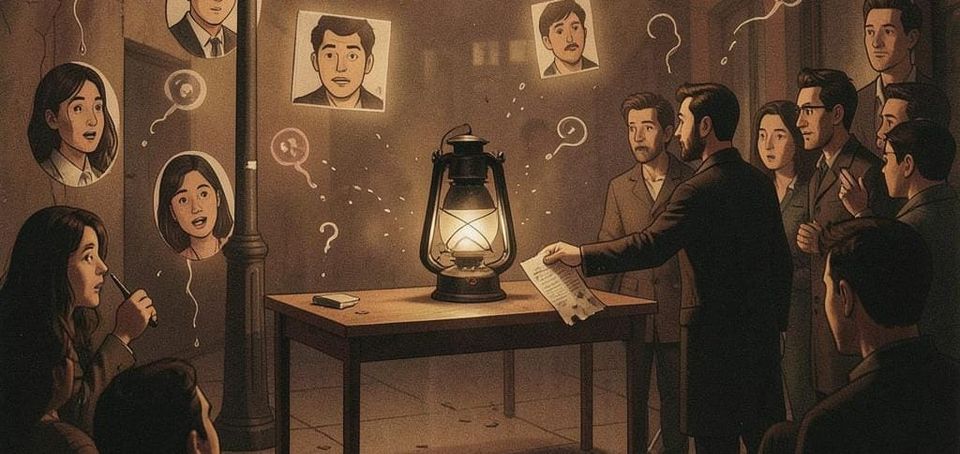
The Sovereignty of the Solitary Stride: On the Metaphysics of Pacing, Evasion, and the Long-Distance Horizon

The Loneliness Of The Long Distance Runner | Lyrics
I never planned the road.
I just stepped onto it.
Sometimes I wander.
Sometimes I run straight.
Sometimes I run so long
the road forgets my name.
Dawn breaks like a starting gun
Sky still bruised from yesterday
No crowd at the roadside waiting
No banners in my way
Shoes hit rhythm on the asphalt
Breath cuts clean and thin
Every mile a quiet question
Every answer — from within
You don’t sprint a lifetime
You don’t fake the pace
You don’t borrow footsteps
You don’t outsource grace
It’s the loneliness
Of the long distance runner
When the noise falls off
And the miles get longer
No shortcut faith
No borrowed thunder
Just heart and bone
And the will to endure
It’s the loneliness
Of the long distance runner
Some chase crowds and quick applause
Some jump lanes mid-stride
Nickel dreams and paper crowns
Trading depth for pride
But I lock into the cadence
Let the tempo burn
Every groove beneath my feet
Is something I had to earn
You don’t skip the album
You don’t cut the side
You don’t quit at mile ten
You let the whole thing ride
It’s the loneliness
Of the long distance runner
When the silence speaks
And the truth runs under
No flash fire fame
No trend to plunder
Just breath and blood
And a steady hunger
It’s the loneliness
Of the long distance runner
There are days the road goes dark
Days the ribs pull tight
Days the only thing that moves
Is stubborn light
I don’t stop.
I don’t turn.
I don’t barter miles for ease.
The road and I
Have an understanding.
Left foot. Right foot.
Left foot. Right.
Groove in the gravel
Groove in the night.
Locked in motion
Locked in flame
Locked in a rhythm
That won’t take a name.
It’s the loneliness
Of the long distance runner
When the crowd fades out
And the truth gets louder
No instant crown
No easy wonder
Just skin and steel
And a will that’s harder
It’s the loneliness
Of the long distance runner
I never planned the road.
I just run it.
And I don’t stop
until the end.

One. The Anatomy of the Solitary Track.
To run long distance is to enter into a contract with depletion. Unlike the sprinter, who operates in a state of explosive surplus, mobilizing the body’s anaerobic reserves in a singular, theatrical burst of defiance against gravity and time, the long-distance runner is an accountant of scarcity.
The runner does not conquer space; they negotiate with it, footstep by footstep, trading small increments of metabolic energy for small increments of horizon.
But the physical reality of the runner is merely the surface of a far more profound existential architecture.
When Alan Sillitoe penned The Loneliness of the Long Distance Runner in 1959, he was not merely describing a cross-country race in the English Midlands; he was identifying a fundamental human posture: the deliberate cultivation of isolation as a form of sovereign defense.
The "loneliness" of the runner is not a pathology to be cured, nor is it the melancholy of the abandoned. It is an active, kinetic hermitage.
It is the realization that in the face of institutional machinery, social expectation, and the gravity of collective consensus, the only way to preserve an authentic interiority is to outpace the grasp of the crowd.
This loneliness is rhizomatic; its roots do not plunge straight down into a single soil but spread horizontally, tangling with the disparate systems of our world.
It explains the silent trajectories of deep-space probes, the computational exhaustion of cryptographic algorithms, the hermetic architecture of the creative genius, the behavior of prime numbers along the infinite line of arithmetic, and the very thermodynamic decay of the universe itself.
Wherever there is a system that must sustain its identity over vast stretches of time or space through a process of self-regulated pacing, the archetype of the long-distance runner emerges.
It is the philosophy of the stride—the rhythmic, repetitive, and solitary assertion of existence against the background noise of nothingness.
Two. The Political Sabotage of the Uncrossed Finish Line.
In Sillitoe’s original narrative, the protagonist, Colin Smith, a reform-school boy, is groomed by his governor to win a prestigious cross-country race. The governor sees
Colin’s athletic talent as a vindication of the institution’s disciplinary power—a demonstration that the deviant can be reformed, channeled, and ultimately utilized to gild the reputation of the establishment.
Yet, at the very climax of the race, with the finish line in sight and victory assured, Colin stops. He stands still, letting his competitors pass him, choosing defeat in the eyes of the crowd to secure a victory in his own mind.
This act of stopping is the ultimate manifestation of the long-distance runner’s loneliness. It reveals that the runner’s true race is never against the other competitors, nor is it run for the spectators in the grandstand.
The true race is an internal dialogue between the self and the track. By refusing to cross the finish line, the runner breaks the circuit of utility. They refuse to allow their endurance to be converted into the social currency of the institution.
This is a political philosophy of evasion. It finds its modern echo in the concept of the strike, not merely as a temporary withdrawal of labor, but as a permanent refusal to participate in the metrics of productivity.
The long-distance runner who stops before the line is the ancestor of the contemporary dropout, the practitioner of "quiet quitting," and the advocate for degrowth. They understand that to win the race on the terms of the institution is to lose the self.
Loneliness, in this context, is the protective moat one digs around one's autonomy. It is the realization that the only way to remain unco-opted is to remain unclassified, running at a pace that others can observe but never direct.
Three. The Voyager Probes and the Loneliness of the Heliopause.
If we lift our gaze from the muddy tracks of the English Midlands to the cold expanse of the cosmos, we find the archetype of the long-distance runner embodied in Voyager 1 and Voyager 2.
Launched in 1977, these twin spacecraft have become the ultimate long-distance runners of human history. Having completed their grand tours of the outer planets, they have crossed the heliopause—the boundary where the solar wind gives way to the interstellar medium—and are now hurtling through the silent, dark vacuum of deep space.
The loneliness of these probes is thermodynamic and communicative. They operate on a dwindling supply of plutonium-238, their nuclear batteries decaying at a predictable, agonizingly slow rate.
To survive, their onboard computers must engage in an extreme form of pacing: shutting down non-essential instruments, turning off heaters, and husbanding every milliwatt of power to keep their weak transmitters aligned with a distant, shrinking Earth.
The signal from Voyager 1 takes over 22 hours to reach us, traveling at the speed of light. It is a whisper of 20 watts—the power of a refrigerator bulb—transmitted across 15 billion miles of nothingness.
Like the runner whose breathing becomes a rhythmic grunt in the ears of no one but themselves, Voyager speaks to an audience that can barely hear it, using a language of binary pulses that grows fainter with each passing epoch.
The probe’s journey is a physical manifestation of the long-distance runner's dissociation.
In the deep stages of an ultramarathon, the runner’s mind detaches from the immediate suffering of the limbs; the body becomes a distant machine, operating on automated instructions while the consciousness retreats into a silent, observational core.
Voyager is that detached consciousness, carrying the golden record—a message of hope from a species it has left far behind—into an infinite, indifferent night.
Four. Cryptography, Proof of Work, and the Computational Marathon.
To find the long-distance runner in the digital realm, one must look to the architecture of blockchain technology, specifically the "Proof of Work" consensus mechanism that underpins Bitcoin. Here, the runner is not made of flesh or metal, but of silicon and electricity.
In a Proof of Work network, computers (known as miners) compete to solve a highly complex cryptographic puzzle. This process is essentially a blind, brute-force search through a mathematical labyrinth.
The miners must hash the data of the current block of transactions along with a random number (a "nonce") until they find a hash that meets a specific difficulty target. This is not a task of sudden, brilliant insight; it is a relentless, repetitive grind. It is a computational marathon.
The "loneliness" of the miner is systemic. Although thousands of machines are running the same race simultaneously, they cannot help each other.
They operate in absolute isolation, burning vast quantities of thermodynamic energy to find a needle in an infinite digital haystack. There are no shortcuts, no pacing hacks, and no ways to split the distance.
Each miner must run their own race, relying entirely on their own hashing power.
The elegance of this system lies in its resistance to co-optation. Just as Colin Smith’s refusal to win was an unalterable statement of personal sovereignty, the difficulty adjustment of the Bitcoin network ensures that no matter how fast the runners become, the race will always take approximately ten minutes.
The system self-regulates its own horizon. It forces the runners into a permanent state of pacing, ensuring that the computational energy expended is always proportional to the security of the network.
The Proof of Work is a monument to the lonely, costly, and unyielding nature of truth in a decentralized world.
Five. The Monastic Desert and the Liturgy of the Step.
To understand the spiritual dimension of this loneliness, we must travel back to the fourth century to the deserts of Egypt and Syria, where the Desert Fathers—the first Christian monastics—fled the imperialized cities of the Roman Empire.
These ascetics, such as Anthony the Great and Simeon Stylites, were known as monachoi—solitary ones. They were the long-distance runners of the spirit.
The desert was not merely a geographic location; it was a blank canvas, an existential track where all social distractions were stripped away, leaving the monk alone with their thoughts, their demons, and their God.
The monastic life was structured around the concept of ascesis (originally a Greek term referring to athletic training). The monk’s day was a masterclass in pacing: a repetitive cycle of prayer, manual labor, and fasting designed to tame the passions and cultivate hesychia—inner stillness.
In this monastic marathon, the repetitive prayer (such as the Jesus Prayer: "Lord Jesus Christ, Son of God, have mercy on me, a sinner") functioned exactly like the rhythmic breathing or the footfalls of the runner.
It was an anchor for the mind, a way to prevent the consciousness from wandering into the past or the future, trapping it instead in the eternal present of the stride.
The loneliness of the monk was not a rejection of humanity, but a belief that by running this spiritual marathon in isolation, they could hold the world together from its margins.
They believed that the solitary struggle against temptation in the desert was more politically and spiritually significant than any action taken in the forums of Rome or Constantinople.
Like the runner who feels a strange, transcendent connection to all of humanity precisely when they are most alone on the trail, the monk found a universal communion in the depths of their self-imposed exile.
Six. The Prime Numbers as Lonely Runners on the Arithmetic Line.
In the abstract realm of pure mathematics, we find a beautiful, haunting analog to the long-distance runner: the prime numbers.
A prime number is an integer greater than 1 that has no positive divisors other than 1 and itself. They are the indivisible building blocks of the number line, the atomic elements from which all other numbers are constructed through multiplication.
Yet, as we journey further down the infinite track of the number line, the primes behave like runners who are slowly losing their pack.
This phenomenon is described by the Prime Number Theorem, which dictates that the density of prime numbers decreases as we move toward infinity. Near the beginning of our journey, primes are common: 2, 3, 5, 7, 11, 13.
But as the numbers grow larger, the gaps between them widen. They become increasingly isolated, separated by vast deserts of composite numbers.
The primes are the ultimate solitary runners. They cannot be broken down, they cannot be factored, and they share no common ground with their neighbors.
They stand alone, markers of an underlying, mysterious order that mathematicians have spent millennia trying to decipher.
The Riemann Hypothesis, perhaps the most famous unsolved problem in mathematics, suggests that the distribution of these prime runners is not random but follows a strict, elegant music—a hidden rhythm dictated by the zeroes of the Riemann zeta function.
If this hypothesis is true, it means that even in their infinite loneliness, the prime numbers are pacing themselves to a cosmic beat, maintaining a precise, mathematically ordained distance from one another as they run into the endless void of infinity.
Seven. Proust’s Cork-Lined Room: The Marathon of Memory.
To translate the physical exhaustion of the runner into the realm of literature, one must examine the life of Marcel Proust.
In 1909, suffering from severe asthma and devastated by the death of his mother, Proust retreated into a cork-lined bedroom at 102 Boulevard Haussmann in Paris.
There, in almost total isolation, he embarked on the writing of À la recherche du temps perdu (In Search of Lost Time)—a novel of over 3,200 pages and 1.2 million words.
Proust’s writing of this masterpiece was a literary ultramarathon. He wrote mostly at night, keeping the windows closed to exclude pollen, the walls lined with cork to deaden the noise of the street, and his body fueled by caffeine and starvation.
He knew that his time was limited, that his failing health was a ticking clock, and that he had to pace his remaining energy perfectly to reach the end of his monumental task.
The loneliness of Proust was the necessary condition for his creative method. To retrieve the past, to capture the ephemeral, involuntary memories triggered by a madeleine dipped in tea, he had to silence the present.
He had to run away from the glittering Parisian salons he had once frequented, withdrawing into a space where the only voice he could hear was the internal monologue of his own memory.
The resulting novel is a monument to the pacing of consciousness. Proust’s sentences are famously long, winding, and complex—they are sentences that run a marathon of their own, lunging forward with clauses, sub-clauses, and parenthetical digressions, refusing to stop for a breath until they have exhausted every nuance of the psychological landscape.
Like the long-distance runner who must maintain a steady rhythm to survive, Proust used the rhythm of his prose to keep death at bay until the final "Finis" could be written.
Eight. The Neurobiology of Dissociation: The Ultramarathoner’s Brain.
What happens to the human machine when it is subjected to the prolonged stress of the long-distance run? Here, the lateral connection shifts from the cultural and mathematical to the neurobiological.
When a runner pushes past the twenty-mile mark, they inevitably encounter "the wall"—the point at which the body’s glycogen stores are entirely depleted, and the liver must begin the slow, inefficient process of converting fat into energy.
This is not merely a metabolic crisis; it is a neurological one. The brain, which relies on glucose as its primary fuel, begins to panic. It floods the system with stress hormones—cortisol and adrenaline—demanding that the body stop.
To survive this crisis, the experienced ultramarathoner must undergo a cognitive shift.
They must activate what neuroscientists call the "default mode network" (DMN) while simultaneously dampening the activity of the prefrontal cortex—the seat of executive function, planning, and self-evaluation.
This state, often referred to as "flow" or "the runner’s high," is characterized by a profound sense of dissociation.
In this state, the runner’s sense of self dissolves. The boundaries between the body and the environment blur.
The pain is no longer "my" pain; it is simply a physical sensation occurring within a wider field of awareness.
The runner becomes an observer of their own movement, watching their legs swing forward like pistons in a machine they no longer fully own.
This neurobiological dissociation is the physical engine of the runner’s loneliness. It is a state of consciousness that cannot be shared.
Even if you are running shoulder-to-shoulder with another human being, you cannot invite them into this neurochemical sanctuary.
It is an evolutionary defense mechanism: when the body is pushed to its absolute limits, the ego must be turned down like a lamp, leaving only the ancient, animal rhythm of the stride to carry the organism home.
Nine. Symbiogenesis: The Mitochondrial Marathon of Complex Life.
To find the evolutionary roots of this endurance, we must descend into the deep history of life on Earth—specifically, to the event known as symbiogenesis, which occurred approximately 1.5 billion years ago.
Before this event, life on Earth consisted entirely of simple, single-celled organisms (prokaryotes) that generated energy through anaerobic pathways—processes that were inefficient and could only support basic cellular functions.
Then, an ancient bacterium made a fateful, long-distance pact: it was engulfed by another cell but, instead of being digested, it was preserved, entering into a permanent symbiotic relationship.
This engulfed bacterium eventually evolved into the mitochondrion, the powerhouse of the eukaryotic cell.
The mitochondrion brought with it the gift of aerobic respiration—the ability to use oxygen to convert nutrients into adenosine triphosphate (ATP) with an efficiency that was eighteen times greater than anaerobic glycolysis.
This metabolic leap is what made complex, multicellular life possible. It is what allows us to run.
But this partnership is marked by a deep, evolutionary loneliness. Mitochondria still retain their own distinct DNA, separate from the DNA found in the nucleus of our cells.
They replicate independently, passing down through the maternal line in a silent, parallel lineage that has remained unbroken for over a billion years.
Every stride we take as runners is powered by these ancient, alien engine-rooms residing within our muscles.
When we run a marathon, we are mobilizing a billion-year-old metabolic pact. The exhaustion we feel is the exhaustion of the mitochondrion, which must continuously pump protons across its inner membrane to keep the ATP synthase turbines spinning.
The long-distance runner is not a singular organism; they are a walking ecosystem, running a race that was mapped out in the primordial soup by organelles that chose a life of permanent, interior exile within our flesh.
Ten. The Corporate Treadmill and the Irony of Hyper-Connectivity.
In the contemporary landscape of late capitalism, we find a perverse, ironic inversion of the long-distance runner’s loneliness.
This is the world of the corporate bureaucrat, the knowledge worker, and the gig-economy driver, all of whom are locked into a cycle of endless, repetitive labor that mimics the mechanics of the marathon but lacks any of its sovereign, redemptive potential.
In this environment, the "track" is the digital workspace—Slack channels, Zoom meetings, email threads, and performance metrics.
The modern worker is subjected to a regime of hyper-connectivity, constantly bombarded by notifications, demands, and feedback loops.
They are never alone; they are plugged into a global network that operates 24/7, demanding constant responsiveness and flexibility.
Yet, this hyper-connectivity produces a profound, alienated loneliness.
It is the loneliness of the treadmill, where immense energy is expended, but no ground is covered. Unlike the long-distance runner who uses their isolation to escape the control of the institution, the corporate worker’s isolation is weaponized against them.
They are physically isolated in their home offices or cubicles, yet digitally monitored and managed, their performance tracked by algorithms that measure keystrokes, response times, and sentiment.
This is the long-distance run stripped of its horizon. It is a race with no finish line, no stopping point, and no opportunity for sovereign withdrawal.
The corporate treadmill is the nightmare of the runner: a state of permanent mobilization where the rhythm of the stride is dictated not by the body’s metabolic wisdom, but by the relentless, external demands of the market.
It is a loneliness of depletion without the dignity of the trail.
Eleven. The Geometry of Evasion: The Dissident under the Panopticon.
To understand how the long-distance run can be used as a weapon against this totalizing surveillance, we must look to the geometry of evasion—the tactics of the political dissident operating under a panoptic regime.
In his seminal work Discipline and Punish, Michel Foucault described the Panopticon—an architectural design that allows a single watchman to observe all inmates of an institution without them being able to tell whether they are being watched.
The power of the Panopticon relies on the internalization of the gaze; the inmate, believing they are always observed, regulates their own behavior, becoming the instrument of their own subjection.
But the long-distance runner breaks this geometry. The runner is a moving target. By leaving the static cells of the institution and taking to the road, they introduce a variable of speed and distance that the panoptic gaze cannot easily track.
This was the strategy of the dissidents in Soviet-era Eastern Europe, who used long-distance running and hiking clubs as covers for political organizing.
Under the guise of athletic training, they would travel to remote forests and mountain ranges—places where the microphones of the secret police could not reach, and where the physical demands of the terrain excluded all but the committed.
On these long-distance mountain runs, the dissidents found a physical and political sanctuary. The rhythm of their steps became a counter-melody to the state’s propaganda; the silence of the forest, a shield for their conversations.
They understood that the panopticon requires static, predictable subjects.
By moving continuously, by pacing themselves across vast distances, they carved out a mobile, sovereign territory that the state could neither colonize nor comprehend.
Twelve. The Cosmological Marathon: Entropy and the Heat Death of the Universe.
Finally, we must scale our analysis to its ultimate, terrifying limit: the history and fate of the universe itself. If we view the cosmos through the lens of thermodynamics, we see that it, too, is running a long-distance race—a race against its own internal decay.
This race is governed by the Second Law of Thermodynamics, which states that the total entropy (a measure of disorder and useless thermal energy) of an isolated system must always increase over time.
The universe began in a state of extremely low entropy—a highly organized, hot, and dense singularity. Since the Big Bang, it has been expanding, cooling, and dispersing its energy across an ever-widening canvas of space.
The stars are the runners in this cosmological marathon. They burn through their nuclear fuel—hydrogen and helium—at a rate that is determined by their mass.
Massive blue stars are the sprinters of the cosmos; they burn hot and fast, exploding as supernovae in a mere few million years.
Red dwarfs, on the other hand, are the ultra-marathoners. They burn their fuel with an agonizing, beautiful efficiency, pacing themselves to survive for trillions of years.
But the end of the race is inevitable. Eventually, even the longest-lived red dwarfs will exhaust their fuel and fade into black dwarfs.
The universe will enter the era of the Heat Death, or the Big Freeze. In this state, all thermodynamic processes will cease.
Temperature differences will vanish, no more energy will be available to perform work, and the universe will become a cold, dark, and uniform expanse of maximum entropy.
This is the ultimate loneliness of the long-distance runner. The universe, having run its multi-trillion-year race, will finally come to a stop.
The expansion will continue, but there will be nothing left to observe it—no stars to light the darkness, no minds to measure the passage of time.
The cosmological stride, which began with the explosive shout of the Big Bang, will end in the absolute, silent stillness of the vacuum.
Thirteen. The Sovereign Synthesis: The Ecstasy of Exhaustion.
We have traced the archetype of the long-distance runner across a vast, rhizomatic network of connections:
From the political defiance of Colin Smith to the silent trajectory of Voyager 1; from the thermodynamic grind of cryptographic miners to the contemplative prayer of the Desert Fathers; from the lonely distribution of prime numbers to the cork-lined sanctuary of Marcel Proust;
From the neurobiology of dissociation to the evolutionary legacy of our mitochondria; and from the alienation of the corporate treadmill to the political sanctuary of the dissident, ending finally in the cold, entropic silence of the cosmos.
What, then, is the unifying truth of this archetype? What is the common thread that binds the mitochondrion to the star, the mathematician to the monk?
It is the realization that isolation is not the absence of life, but the crucible of its preservation.
In a world that is constantly demanding connection, integration, productivity, and conformity, the act of pacing oneself in isolation is a revolutionary gesture.
It is the assertion that one’s life, one’s work, one’s energy, and one’s destiny belong to no one but the self.
The loneliness of the long-distance runner is not a burden to be carried; it is a sovereignty to be celebrated.
It is the ecstasy of exhaustion—the point where the noise of the world falls away, the ego dissolves, and nothing remains but the clean, rhythmic, and unyielding assertion of existence.
Whether we are running on a muddy track in the rain, writing a multi-volume novel in a dark room, or hurtling through the interstellar void at thirty-eight thousand miles per hour, we are all, in our own way, pacing ourselves toward our own horizons.
And in that solitary, self-regulated stride, we find the only true freedom we will ever know.

William On Time... l Lyrics
Let's get started, shall we?
Wow. It's 5:30 pm. Where did the time go. I remember this morning - when I popped up to make a tune or whatever - cause I got, or - I caught an idea (both me actively catching it, and also like catching a cold).
Where did the time go? We say that. All the time.
I remember this morning just like it was yesterday. That's how it came out - when I was talking to you, to Willie, you, Willie - this morning just like it was yesterday.
I think there a things called, "Moments." Indeed, there are such things: For, two people can be together, getting ready to kiss, for the very first time - and somebody, usually a friend - walks up, and farts. It's not unlikely one of the two who were to kiss says: "Well. That certainly did ruin the moment." Probably not out loud. But more to himself - than to either of the other two.
Moments do exist. And I get 'swept up' - those are the words that came to mind right as I was finishing typing the word, 'get.'
[short pause]
...
Swept up. Not into any idea. No. That's different. Way different.
We catch ideas - get them, have them - whatever. I already had the idea. I popped up from the bed just like that! Meaning, this: The Idea hits me. I see it. I turn it over. Look at it. And once I agree - once I give consent - that's when the Moment Swoops in and Sweeps me up.
Hello, is this microphone on? Good. Wow, it's 5:30 in the afternoon. It was just 7:30 in the morning, or 8, or whatever time it was when I popped up to do whatever. Make a tune. So I was just in there peeing, and I was peeing a good bit. I hadn't been in there a minute.
I've been in here just focusing and concentrating. And when I get focused and concentrated, here's the thing that occurred to me while I was sitting there peeing for like five fucking minutes, sitting down. The day just flies by. At the end of the day, I'm like, holy shit, I can't believe it's fucking time. But while I'm in it, it doesn't fly by.
It moves. It dances with me, right?
It's like I'm in this moment. And, when the moment finally opens up later and sets me down, then I'm like, wow. That just fucking flew by like nothing. But while I'm in it, it's very compressed, I guess. Super compressed.
It's weird. I don't know how to explain it.
But it was something that occurred to me enough such that I wanted to come in here and talk about it. This feeling of time.
Again, the way I thought of it while I was sitting there on the john taking a leak - was this.
I'm in a moment. And a moment is not like a single moment, like a tick on a clock. Because someone can walk in and fart and fucking ruin the moment between two people who are getting ready to kiss. Just fucking ruin the moment, right? A moment, a moment is something else.
It's a... It's a gesture, I guess. It's an embracing of the environment and the people in it. It's a wrapping around them and holding them tight, keeping them in and everything else out. And while you're in it, and no one else is in it, and everybody else is out of it, while you're in it, it's just, you dance with it. It dances with you. And then when it opens up later, because it has to, it has to release you at some point, you cannot live in any moment. But I get in these moments, man. They last all day. These super long distance running moments. I'm in it. I cannot believe it's 5:30 in the afternoon.
It's just 7:30. I remember. It's just like, just like, just like yesterday. Just like it was yesterday. Yes. I remember this morning, just like it was yesterday. That's a great line. That's what came to mind, though. Just like it was yesterday.
Because most of the time we say, wow, that was, how long ago was that? Like three, four, five weeks? Wow, it feels like it was just yesterday. That's the same feeling. That's why that word came up, the same feeling.
Is that this has been going on for three, four, or five weeks or something like that, and I can't fucking believe it or something like that. I'm gonna send this along and let you untangle what I just gave you.
 Outlaw Creative
 Outlaw Creative
 Outlaw Creative