
The Frequency Of The Forest: On The Rhythm That Called The Witch & The Architecture of Emergence
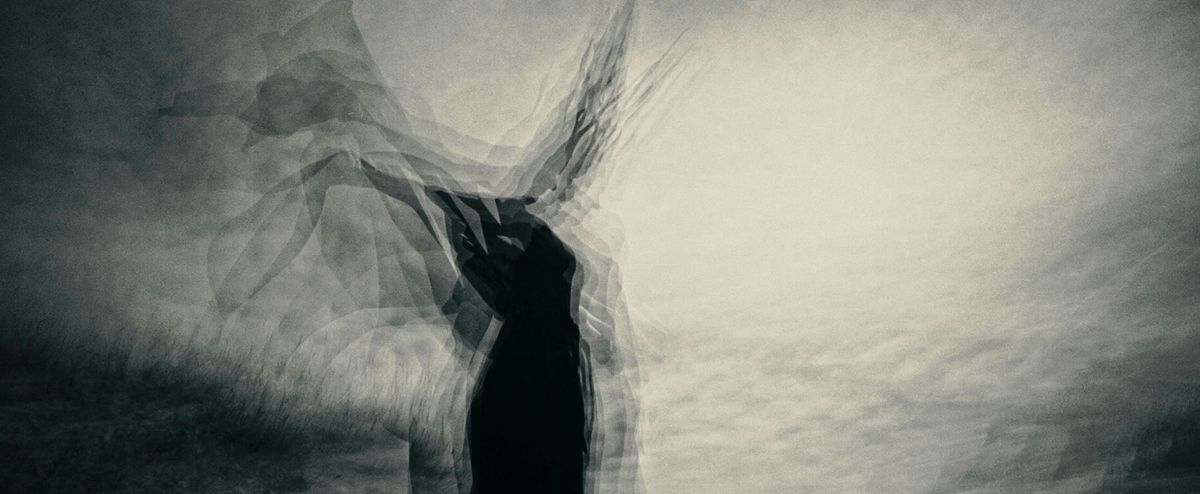

The Rhythm That Called The Witch | Lyrics
I was raised on a red clay ridge,
Where the pines lean in and the shadows twitch,
Where the wind don’t blow unless it’s got a mind,
And my Grandaddy watched with eyes like time.
He wore boots like iron, slow to speak,
Kept salt on the sill and ash at his feet,
He’d knock on wood three times, real light,
Said, “The air’ll tell you when something ain’t right.”
Mama said he was touched, half mad,
But he saw things I never knew I had.
He’d say, “Some folks rot just standin’ still,
And you don’t need fire to feel the chill.”
He was a witch hunter, but not like the tales,
He hunted the rhythm where decency fails.
Not broomsticks or spells or black-cat cries,
But the cold in the room when a good thing dies.
The laugh at a funeral, the smile that sticks,
The woman who talks but her shadow don’t flick.
He’d stare ‘til the wickedness started to twitch—
He heard the rhythm.
The rhythm that called the witch.
Neighbor boy whistled through crooked teeth,
Always came round when the cows wouldn’t eat.
Grandaddy’d spit and say “Stay back, child—
His mama talks soft but her eyes too wild.”
I thought it was nonsense, an old man’s game,
Till the birds stopped singin’ when they said her name.
He once drew salt ‘round a maple tree,
Said, “That ain’t wood—it’s remembering me.”
The preacher wore white but his hands felt red,
He’d say all grace with a tilt of the head.
Grandaddy stood at the back that day,
And the candles shook like they wanted to say.
He was a witch hunter, but not like the tales,
He hunted the rhythm where kindness pales.
Not cauldrons or curses or silver knives,
But the turn in the tone of a lover who lies.
The hush in a field that should buzz and hum,
The echo that answers before it’s begun.
He’d look, and the wrong would start to twitch—
He heard the rhythm…
The rhythm that called the witch.
He never raised hand, never raised voice,
But the trees bent close like they made their choice.
He said, “Boy, if the corn don’t grow by June,
It ain’t the soil—it’s the breath of the room.”
Now he’s gone, and I feel it near—
That shift in the wind, that tickle of fear.
I knocked on wood just the other night,
Felt the porch breathe wrong in the pale blue light.
Saw a girl laugh hard at her mama’s grave,
Felt the earth shiver, quiet and brave.
I didn’t speak, just watched her flinch—
I guess I know now what it means to pinch.
That rhythm.
He was a witch hunter, not with torch or flame,
But with knowing eyes that called out the name.
He listened for silence that cracked like bone,
For the empty chairs where lies are sown.
And I used to think he was just strange and stiff,
But now I walk with that same old gift.
And when the air pulls tight and the shadows itch—
I hear the rhythm.
The rhythm that calls the witch.
The Frequency Of The Forest: On The Rhythm That Called The Witch & The Architecture of Emergence

To understand the witch, one must first abandon the caricature of the pointed hat and the bubbling cauldron. Instead, we must understand her as the ultimate figure of the transgressive emergent—that which lies dormant at the periphery of ordered systems until a specific cadence, a precise frequency of disruption, calls her into being. The statement, "On The Rhythm That Called The Witch" is not a fable of medieval superstition; it is a foundational axiom of complexity theory, cybernetics, aesthetics, and historical materialism. It asserts that order does not merely generate its own opposition, but that order, when patterned in a specific, repetitive, and rhythmic manner, actively entrains the very forces that will dismantle or transfigure it.
The "rhythm" is the structure, the algorithm, the recurring cycle, the heartbeat of the status quo. The "witch" is the anomaly, the wild card, the subterranean energy, the phase transition, the black swan. To study this relationship is to embark on a rhizomatic journey across seemingly disparate domains of human knowledge and natural phenomena. We must trace how specific patterns of repetition inevitably summon their own haunted, destabilizing counter-memes.
I. Cymatics and the Geometry of the Unseen
We begin in the materialist theater of acoustics. In the late eighteenth century, Ernst Chladni demonstrated that when a metal plate covered with sand is stroked with a violin bow, the chaotic grains do not scatter at random. Instead, they migrate to the nodal lines where the plate does not vibrate, organizing themselves into intricate, beautiful geometric patterns.
This is the most literal physical instantiation of our statement. The violin bow provides the rhythm—a sustained, oscillating frequency. The sand, previously a formless drift of potentiality, is "called" into a highly specific, quase-organic form. Here, the "witch" is the sudden appearance of symmetry from chaos.
If we increase the frequency, the complexity of the pattern increases. The rhythm does not merely move the matter; it dictates the limits of its form. In this light, physical matter is not a static substance but a temporary arrest of motion, a shape held in place by a continuous hum. The witch is always waiting in the silence between the vibrations; change the rhythm, and she shifts her shape, restructuring the world in her image.
[Sustained Frequency / Bow] ---> (Vibrational Node) ---> [Geometric Emergence / Sand Pattern]
         (Rhythm)                                                 (The Witch)
II. Algorithmic Feedback Loops and the Digital Uncanny
Let us slide laterally from acoustic plates to the silicon valleys of the twenty-first century. Consider the feed-mechanisms of contemporary social media platforms. These systems operate on a rhythm of micro-interactions: the scroll, the double-tap, the pause over an image, the frantic typing of a comment. This rhythmic behavior is harvested by algorithms designed to maximize engagement.
What is the "witch" summoned by this relentless digital pulse? It is the polarization of the public sphere, the sudden crystallization of hyper-niche, radicalized subcultures, and the birth of the digital uncanny. The algorithm does not have a political ideology; it merely seeks a resonance. It discovers that outrage, conspiracy, and extreme aesthetic styles produce the highest amplitude of user response.
By feeding this rhythm back to the user, the algorithm summons a specter—a collective, decentralized intelligence that operates outside the control of the platform's creators. The QAnon phenomenon, the rapid spread of memetic warfare, and the rise of algorithmic cults are the modern covens, called forth from the dark forests of the internet by the rhythmic click-clack of our own fingers on glass.
III. High-Frequency Trading and the Ghost in the Financial Machine
In the glass towers of global finance, human agency has largely been outsourced to algorithmic trading systems. These programs execute millions of trades per second, operating on timescales invisible to human perception. This is a hyper-rhythm of capital—a relentless, pulsing heartbeat of buy and sell orders.
Yet, this sterile, mathematical rhythm is not immune to the uncanny. Periodically, these systems experience what is known as a "Flash Crash." In a matter of minutes, billions of dollars of value vanish and reappear as algorithms enter runaway feedback loops, reacting to each other's reactions in a spiraling dance of self-reinforcing panic.
The Flash Crash is the "witch" of the financial apparatus. She is the emergent catastrophe born from the extreme speed and repetition of automated trading. She reveals that beneath the illusion of rational market efficiency lies a volatile, non-linear beast that can be awakened by the right combination of high-speed signals. The rhythm of capital, in its quest for absolute optimization, inevitably summons the ghost of its own destruction.
[Hyper-Rhythm of Trades] ---> (Algorithmic Feedback Loop) ---> [The Flash Crash]
       (Rhythm)                                                    (The Witch)
IV. Mycelial Pulses and the Margins of Decay
Leaving the sterile world of finance, we plunge our hands into the damp soil of the forest floor. Here, the rhythm is slower, measured in seasons, moisture levels, and the pulsing decay of organic matter. Mycelial networks—the underground webs of fungal threads—stretch for miles beneath the earth, acting as the nervous system of the forest.
These networks do not grow at random. They expand in rhythmic pulses, sending out hyphae in search of nutrients, retreating from drought, and surging forward with the autumn rains. When the ecological rhythm is precisely right—when the temperature drops, the humidity rises, and the host tree reaches a specific state of senescence—the mycelium does something extraordinary. It sends up a fruiting body: a mushroom.
In folklore, rings of mushrooms were called "fairy rings" or "witches' circles," places of danger and transformation. Scientifically, they are the outward expression of a hidden, rhythmic underground expansion. The mushroom is the "witch" called forth by the subterranean pulse of decay. It is the visible sign of an invisible network, a sudden eruption of reproductive energy that transforms the forest floor and recycles life from death.
V. Photic Driving and the Neurology of the Ecstatic State
Inside the human skull, the brain operates on its own delicate rhythms: the alpha, beta, theta, and delta waves that correspond to different states of consciousness. These rhythms can be externalized and manipulated. Through a process known as "photic driving" or "auditory entrainment," the brain's electrical activity can be forced to synchronize with an external, rhythmic stimulus—such as a flashing strobe light or a monotonous drumbeat.
When the external rhythm reaches a frequency of approximately 8 to 12 Hertz (matching the brain’s alpha wave range), something shifts. The subject begins to experience vivid, waking hallucinations: geometric patterns, swirling colors, and a sense of dissolving boundaries.
This is the biological basis of the shamanic trance and the ecstatic rituals of the ancient world. The "witch" summoned here is the altered state of consciousness itself—the liberation of the subconscious mind from the tyranny of the default mode network. By imposing a rigid, external rhythm on the brain, we unlock the chaotic, creative, and visionary depths of the human psyche. The rhythm acts as a key, unlocking a door that normal, waking rationality keeps firmly shut.
[Flashing Strobe / Drumbeat (8-12 Hz)] ---> (Neural Entrainment) ---> [Hallucination / Trance]
              (Rhythm)                                                      (The Witch)
VI. Haussmann’s Grids and the Specter of the Flâneur
In the mid-nineteenth century, Baron Haussmann demolished the medieval heart of Paris, replacing its labyrinthine, chaotic alleys with wide, straight boulevards and a highly organized, rhythmic grid system. This was an architecture of control, designed to facilitate the rapid movement of troops and capital, and to prevent the construction of revolutionary barricades. The rhythm of the new Paris was one of speed, commerce, and surveillance.
Yet, this very spatial rhythm summoned its own subversive counter-figure: the flâneur. As theorized by Charles Baudelaire and later Walter Benjamin, the flâneur is the passionate spectator, the aimless stroller who refuses the rhythmic demands of industrial time and capitalist productivity. He walks slowly, sometimes leading a turtle on a leash, drifting through the arcades and boulevards.
The flâneur is the "witch" of the modern city. By adopting a rhythm of radical slowness within a space designed for speed, he transforms the capitalist boulevard into a dreamscape, a site of poetic re-enchantment and psychological drift (dérive). Haussmann’s rigid grid, designed to eliminate subversion, inadvertently created the perfect stage for the birth of avant-garde psychogeography.
VII. Evolutionary Prime Numbers and the Cicada’s Song
In the forests of eastern North America, certain species of periodical cicadas spend either 13 or 17 years underground as nymphs, feeding on the sap of tree roots. Then, with astonishing synchronicity, millions of them emerge simultaneously, filling the air with a deafening, rhythmic mating song that can reach 100 decibels.
Why 13 and 17 years? These are prime numbers. This mathematical rhythm is an evolutionary strategy designed to defeat predators. If the cicadas emerged every 12 years, predators with 2, 3, 4, or 6-year life cycles could easily synchronize their population booms with the cicada emergence. By choosing a prime number, the cicadas ensure that their emergence rarely coincides with the population peaks of their predators—a strategy known as "predator satiation."
The "witch" here is the sudden, overwhelming biological invasion—the transformation of a quiet forest into a buzzing, swarming mass of life. This ecological event is called into being by a silent, mathematical clock ticking underground. It is a rhythm of prime numbers that summons a biological miracle, a temporary disruption of the food chain that leaves predators helpless through sheer, overwhelming volume.
[13 or 17-Year Prime Cycle] ---> (Predator Desynchronization) ---> [Deafening Biological Swarm]
         (Rhythm)                                                          (The Witch)
VIII. The Metrical Spell: How Poetry Bypasses the Censor
Language is not merely a tool for conveying information; it is a physical medium of sound and silence. In poetry, this medium is organized through metre—the rhythmic arrangement of stressed and unstressed syllables. The iamb, the dactyl, the trochee: these are the basic beats of the linguistic drum.
When we read or listen to a poem with a strong, consistent metre, something curious happens to our cognitive processing. The repetitive rhythm lulls the analytical, critical faculties of the left brain into a state of semi-relaxation. It acts as an aesthetic anesthetic.
Once the rational censor is asleep, the poem’s imagery, metaphors, and emotional undercurrents slip directly into the subconscious mind. This is why spells, incantations, and nursery rhymes are almost always written in strong, simple rhythms. The "witch" summoned by the poetic metre is the deep, somatic response of the reader—the sudden tear, the shiver down the spine, the unbidden memory. The rhythm of the verse bypassing our intellectual defenses to touch the raw nerve of our humanity.
IX. Non-Equilibrium Thermodynamics and the Dissipative Structure
In classical physics, the second law of thermodynamics dictates that closed systems always move toward entropy, decay, and disorder. However, in the mid-twentieth century, chemist Ilya Prigogine showed that open systems, which exist far from thermodynamic equilibrium, behave differently. When such systems are subjected to a continuous, rhythmic throughput of energy and matter, they do not dissolve into chaos. Instead, they undergo a sudden phase transition, organizing themselves into highly complex, self-sustaining patterns called "dissipative structures."
A simple example is the Bénard cell: when a liquid is heated evenly from below, a point is reached where conduction fails to transfer the heat fast enough. Suddenly, the liquid organizes itself into a beautiful, honeycomb-like pattern of hexagonal convection cells, which transport the heat far more efficiently.
The Bénard cell—and indeed, life itself—is the "witch" of non-equilibrium thermodynamics. She is the spontaneous emergence of order from disorder, called forth by the steady, rhythmic application of energy. Prigogine’s work reveals that the universe is not a dying clock winding down, but a creative canvas where rhythm is the primary agent of self-organization, constantly summoning new levels of complexity from the void.
[Rhythmic Energy Flux / Heat] ---> (Critical Instability Threshold) ---> [Self-Organized Hexagonal Cells]
           (Rhythm)                                                                (The Witch)
X. The Techno-Ritual and the Collective Ego-Death
We conclude our rhizomatic journey on the modern dance floor. In the dark, cavernous warehouses of contemporary cities, thousands of people gather to dance to techno music. The music is characterized by a relentless, four-to-the-floor kick drum, usually operating at a tempo of 120 to 140 beats per minute, accompanied by hypnotic, repetitive synthesizer loops.
This is not mere entertainment; it is a highly evolved, contemporary form of ritual. The steady, unyielding beat acts as a collective entrainment mechanism. As the night progresses, the individual dancers synchronize their movements, their breathing, and their heart rates to the music and to each other.
At a certain point in the night, a phenomenon known as "the vibe" or "collective effervescence" occurs. The boundaries of the individual ego begin to dissolve. The dancers no longer feel like isolated agents; they feel like cells in a single, massive, breathing organism.
The "witch" summoned by the techno beat is this collective ego-death—the return to a primal, pre-individual state of communion and solidarity. In a highly atomized, hyper-individualistic society, this temporary dissolution of the self is a radical, therapeutic, and deeply political act. The rhythm of the machine, paradoxically, is what summons our most ancient, communal humanity.
XI. Synthesis: The Ecology of the Summoning
Having traced these ten distinct threads, we can begin to synthesize the core philosophical truth of our statement. The relationship between the rhythm and the witch is not one of cause and effect in the classical, linear sense. It is a relationship of resonance and affordance.
   THE RHYTHM (Structure & Pattern)
              │
              ▼ [Continuous Oscillation & Repetition]
   THE LIMIT (Critical Threshold / Phase Transition)
              │
              ▼ [Systemic Break / Emergence]
   THE WITCH (The Transgressive / The Anomaly)
The rhythm does not "create" the witch; rather, the rhythm creates the specific conditions under which the witch can manifest. The witch is always there, latent, existing as a field of possibilities, a cloud of unexpressed potential at the margins of the system. She is the shadow of the structure, the unsaid of the sentence, the noise in the signal.
To understand this dynamic is to possess a powerful tool for analyzing the world. We can see it operating in:
- Politics: Where the rigid, unyielding rhythm of bureaucratic austerity inevitably summons the "witch" of populist revolt or mutual aid networks.
- Psychology: Where the repetitive, traumatic rhythms of daily stress summon the "witch" of neurosis, depression, or sudden, explosive breakthrough.
- Art: Where the strict, formal constraints of a sonnet, a canvas, or a scale summon the "witch" of creative genius and emotional resonance.
- History: Where the cyclical rise and fall of empires—their rhythmic expansions and contractions—inevitably summon the "witches" of barbarian invasions, peasant rebellions, and paradigm shifts.
The lesson of the is that we cannot have one without the other. Those who seek to build perfectly ordered, rhythmic systems—whether they are cities, algorithms, economies, or states—are always, by that very act, writing the music that will summon their own subversion. The more rigid and repetitive the rhythm, the more powerful and transgressive the witch who answers its call.
We must therefore learn to listen to the rhythms of our own lives and our own societies. What patterns are we repeating? What frequencies are we broadcasting? For in the silence that follows the beat, if we listen closely enough, we will hear the rustle of leaves at the edge of the clearing, and we will know that she is on her way.