On The Memory Of The Land & The Bones That Speak
The Bones: Lyrics
The bones?
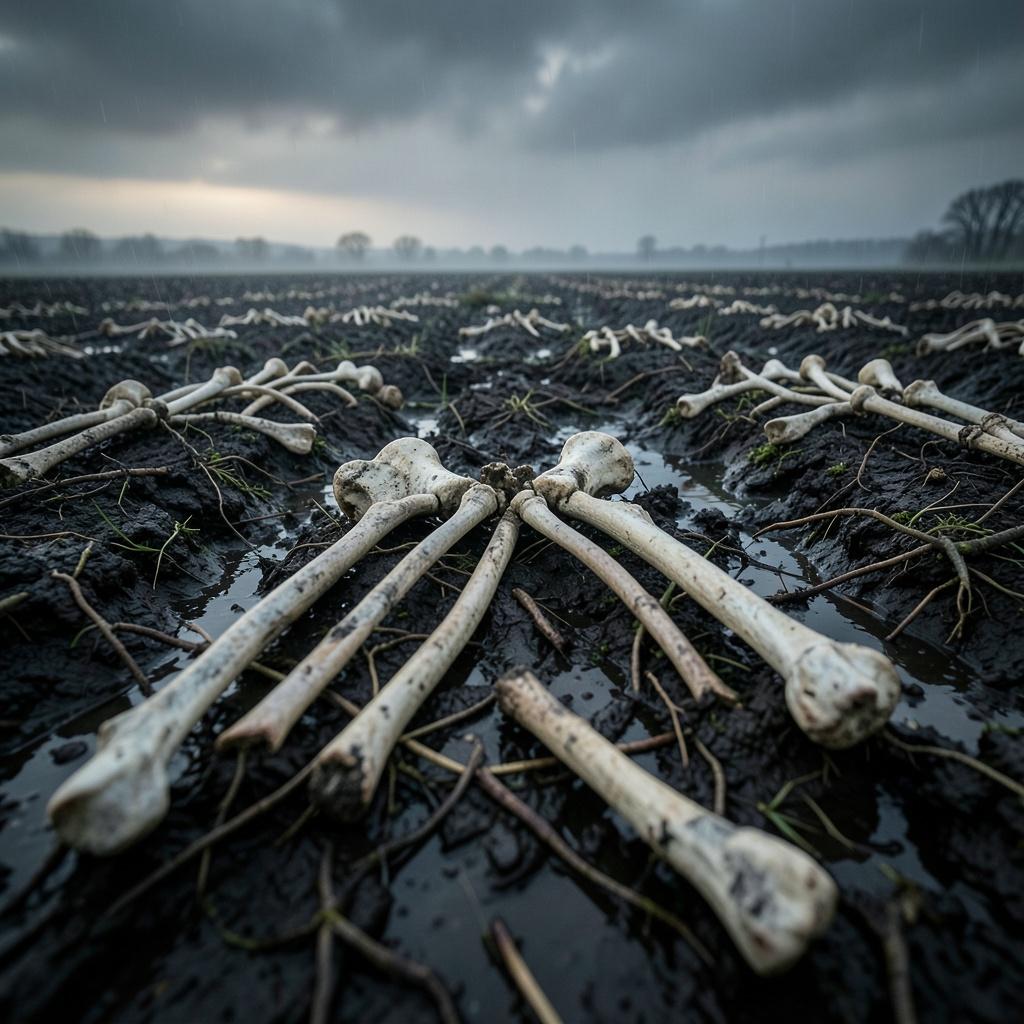
Yes. Still bones. But heavier now. Not because of their weight—no, they have none. Flesh has fled, sinew surrendered. What burdens them is the story sealed inside their marrow, soaked in silence, pressed underfoot until the silence became part of the topsoil.
These bones belonged to those who *believed*. In the light, in the good, in love as something whole. They held it high in their hearts and bore it like a torch into shadowed valleys, into dark fields choked with thorns and righteous laws.
And the land—me—I watched. I bore witness.
I remember the first one.
He came with callused palms and eyes that dared to hope. He believed if he built enough, gave enough, forgave enough, he might carve peace from the stone. His sweat baptized the ground.
His blood watered it. His back broke beneath the banner of goodness, and still—he smiled.
Then he vanished. Quietly. Not even the birds sang that morning. I swallowed his body in cold clay. They called it justice. I called it *murder*.
But I said nothing. I always say nothing.
Because I am the land. I am silence.
Because what good is a screaming field?
The next one came laughing. A woman this time. She danced across my skin, planting herbs and children and old songs. But laughter is a threat to those who serve only rules. They came in the name of law. The same black seal. The same ink-stained fingers. They said her flowers were trespass.
They tore them up by the root.
They tore her up by the root.
And I wept for the first time in many years. I rained until the valley drowned. Her bones still hum lullabies when the wind comes from the east.
You think I don’t know what good is? You think I don’t know what love is?
I have held it. I have watched it rot.
I have seen what is *done to it*.
I know now: the light is not born in comfort. It’s born screaming. It claws its way through the dark.
It *needs* the dark to mean anything at all.
So yes, let me go darker.
Let me bury a thousand more bright hearts in black mud. Let me feed the roots with their final gasps and shattered truths. Let me nurture trees whose bark remembers every lie written in gold foil seals. Let the cities rise taller, colder, sharper—until they must look down, *far down*, to see what they’ve paved over.
And one day, when their steel teeth gnash against something they cannot chew, they’ll dig deep—and find these bones. Still kissed by death. Still holy with labor. Still whispering songs of the ones who gave everything for the light.
And maybe then, the soil will not be silent.
Because bones—
Bones are just bones, yes.
But enough bones become a voice.
And enough voices become a flood.
And when the land breaks, it does not ask permission.
It remembers.
And it rises.
The land remembers. Not in the manner of men who recall, with distortion and desire, but with a patience that exceeds the reach of intention. The land does not select its memories. It receives all of them. Every footprint, every harvest, every burial, every kiss beneath the cypress tree, every wound, every lie shouted across a field, every truth whispered into the soil. All of it remains.
We must not confuse the land with the Earth. The Earth is planetary. It turns and moves. It orbits. It obeys laws. But the land is what we step on. The land is what we build upon, dig into, divide with fences and flags, plow, ruin, praise, possess, inherit. The land is place. The land is always local.
And within it—memory. Not a record, not a scroll, not a database. A memory that is not reducible to information, nor even to history. The memory of the land is the manner in which it has been shaped and borne. It is the feel of absence, the weight of what once was. A house removed leaves a trace. A body buried leaves a story that no mouth may tell, yet every root understands.
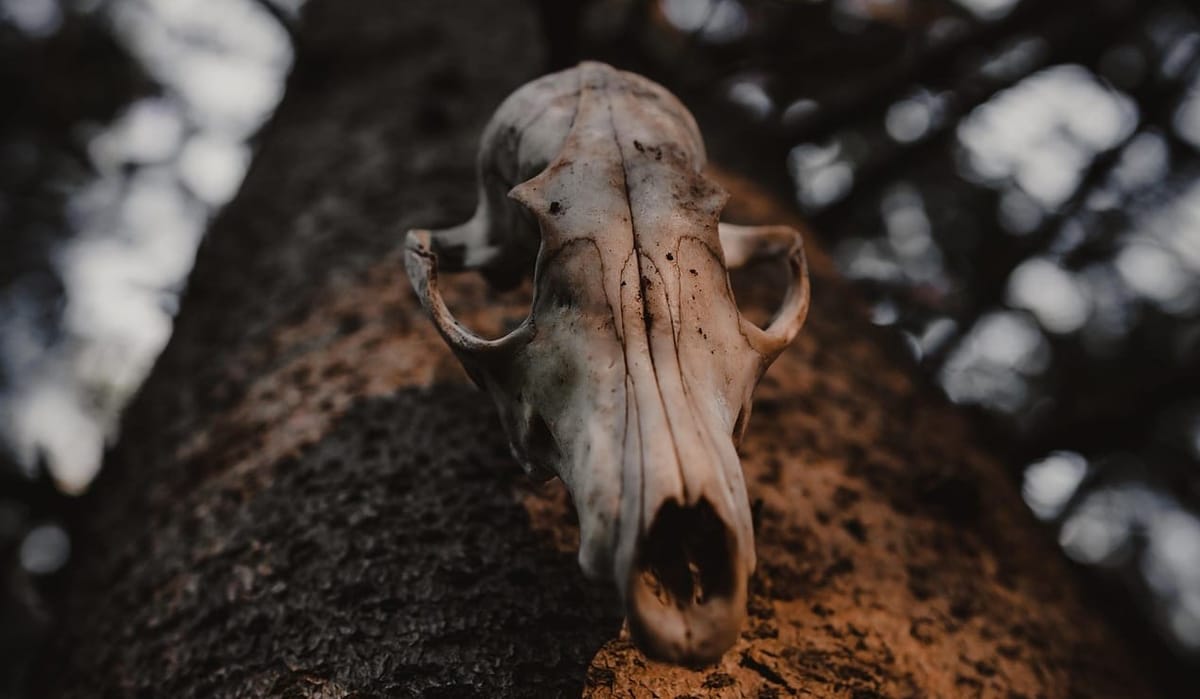
What is a bone but the most stubborn remainder of the living? It does not speak in words. It does not rot with haste. It waits. It testifies without voice. The bone is not an echo—it is the source of echo. And when the land speaks, it does so not in thunder, but through the slow grammar of erosion and bloom.
The land has been touched by bodies. Not just walked on or worked, but carried, stained, shaped by blood and blister, and dream. These bodies suffered and gave. They brought forth fruit. They were kissed by death—not because they failed, but because they were finite, and because all labor is finite, yet not in vain.
There are those who think of death as a ceasing. The land thinks otherwise. It does not carry grief the way a widow might. It does not carry sentiment. But it bears traces. It holds every gesture like a still, ancient photograph. And the bones it keeps—bones of men and women and children and cattle and wolves and deer—these are not just dead things. They are shapes of having-been. And some of them have been kissed by death in such a way that even the land pauses. These are not the anonymous remains of time’s slow erosion. These are the ones the land remembers as lovers.
These bones were once burdened with the weight of tools. They sweated under sun and frost. They bore calluses in the palm and gritted teeth against injustice. They knelt to plant and rose to harvest. And they did so not in abstract devotion but in proximity to family, to hardship, to hope.
The land sings their labor. It does not elevate them as kings. It does not flatter them with monuments. But it refuses to forget them. It cannot forget them, for its very shape has been formed by their touch.
Meanwhile, the city writes. It inks contracts. It stamps orders. It builds its legitimacy upon seals and clauses and the straight lines of legal reason. The court sits in judgment, and judgment sits on the back of precedent. But none of this remembers the land. None of this sees the bone.
The city believes it commands. And for a while, it does. Its voice is loud. Its orders come quickly. It has schedules and deadlines. It calls itself sovereign. But it never built the land. It only inherited its conquest. And it governs not by tending, but by forgetting.
The land, meanwhile, waits. It waits with a patience beyond policy. It does not envy the gavel or the pen. It does not need to rebut the court. Its rebuttal is slow. It swells. It cracks pavement. It grows back over the borderlines. It speaks only when no one listens, and by the time one hears, it is too late to reply.
This is not romanticism. The land is not benign. It is not the gentle mother of sentimental nature. The land can be cruel, and its memory can burn. There are places where the blood cried out so loudly that even now the trees lean away. There are places that will not allow rest. The land carries not only blessing, but curse. And it remembers both with equal fidelity.
To walk on such land is to walk through trial. The trial is not adjudicated—it is endured. And the bones that remain are not evidence for a jury, but presence. Their presence makes demands.
There is an arrogance in our legal orders that supposes all memory must pass through writing. That a title deed is more lasting than sweat. That a signature is more binding than sacrifice. But the land was claimed long before such records were written. It was claimed by the act of living. It was inscribed by every back bent under weight, every knee pressed to the furrow, every breath held as a child came forth.
And the bones that lie beneath? They are not just what remains of the person. They are what remains of the relation. They are not merely inert matter. They are remains of love, of labor, of covenant.
It is a mistake to speak of the land as powerful in itself. The land is not the power. The land bears the power. It receives. It depends. And it is the place where the spirit of the living has pressed so hard, so deep, so often, that the shape of that spirit still lingers.
Bones do not weep. But sometimes the land does. The morning fog that clings to a forgotten field, the ache that fills the chest of a returned son who finds his family’s plot paved over—these are the weepings of the land.
The city calls this sentimental. The law has no category for it. But the bones know. And the land does not forget.
Even now, the birds still speak. The smallest ones—the tinies, as some have called them—scurry beneath the brush. They are not afraid of predators so much as they are animated by an ancient nervousness, a memory older than species, a memory held in the ground beneath them.
The land hears this. It is not omniscient, but it is watchful. It does not calculate, but it discerns. It does not enforce, but it holds.
The land is not a court. But it renders a different kind of judgment. One not based on precedent, but on presence. Not on argument, but on touch. And its final word is not vengeance. It is memory.
There are those who say the land belongs to us. But perhaps it is more true that we belong to the land. Not in the sense of property, but in the sense of being carried. The way a name carries a story. The way a hand carries warmth. The way a grave carries a life.
These bones have danced with death, yes. But they did not vanish. They did not flee. They stayed. And they testify. Not to victory, but to love. Not to dominion, but to labor.
And what shall we say in return?
Shall we pave them over? Shall we build again, as though they were never here? Shall we hold up our documents, our deeds, our digital records, and declare that the land is ours?
The land hears this. It hears, and it smiles, if land can be said to smile. Not with joy, but with the slow curling of something ancient and amused.
Because it has heard these claims before. It has seen kings rise and fall. It has been marked by the boots of armies, the claws of machines, the laughter of children. It has borne witness to the full absurdity of history.
And still, the bones remain. And still, they speak.
They do not shout. They do not interrupt. They simply persist.
They are what the land cannot forget. And we would do well to remember what the land remembers.
Not to control it. Not to master it. But to listen. To receive. To be shaped, as it was once shaped. To become, not owners of the land, but bearers of its memory.
And in bearing it, to live as those who know they will one day be remembered. Not by statute. Not by record. But by touch. By contour. By what we left behind in the way the soil feels when the sun first rises.
The land knows.
The bones remember.
Let us learn, at last, to listen.